UCLA Department of Art History’s Art Council Lecture Series
Colonial Provenance Networks: Haiti and the Paris Art World
Speakers: Meredith Martin (NYU) and Hannah Williams (QMUL)
Location: UCLA, Los Angeles CA
Time and Date: 4:30pm – 28 January 2027
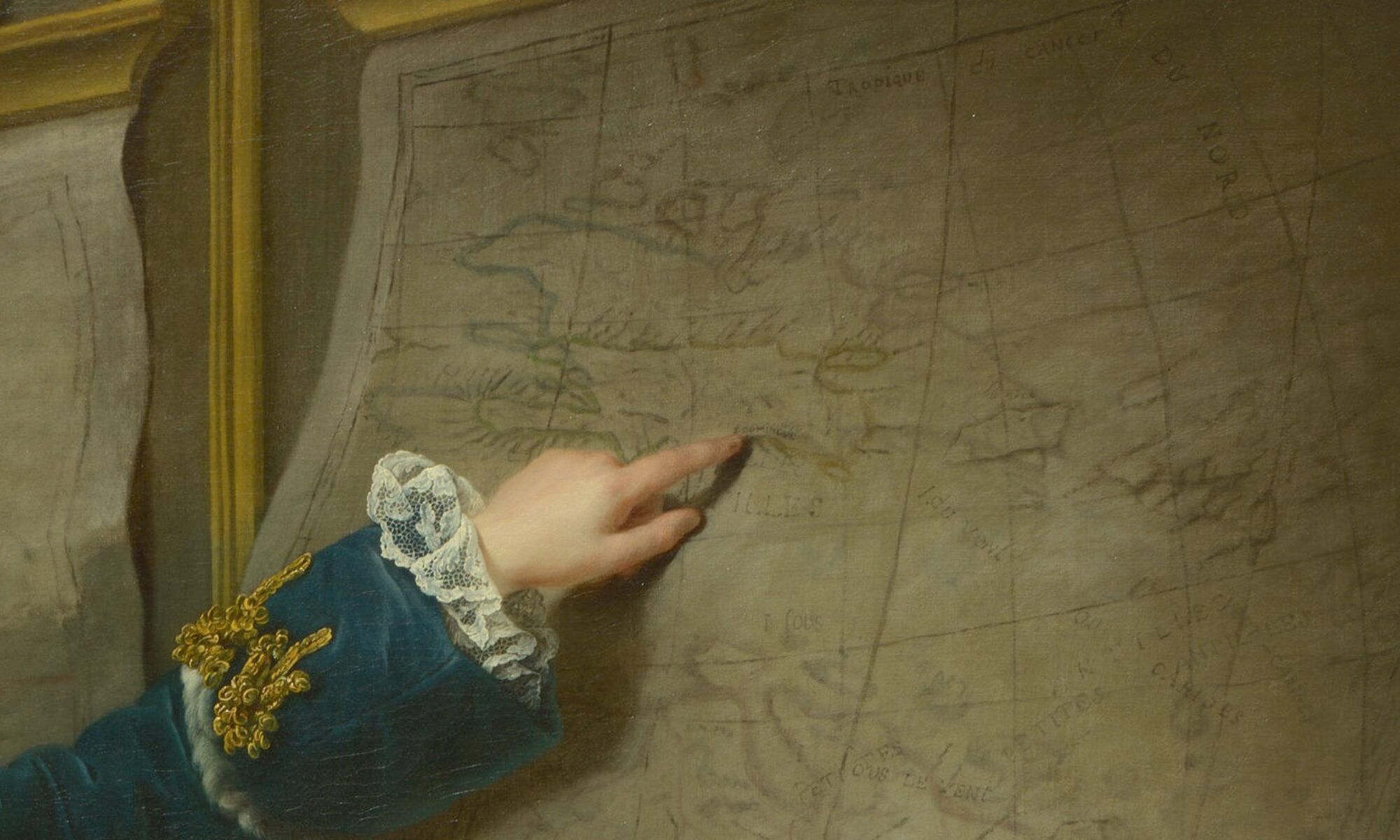
Remapping the “Paris” Art World in Haiti/Saint-Domingue
UCLA Department of Art History’s Art Council Lecture Series
Speakers: Meredith Martin (NYU) and Hannah Williams (QMUL)
Location: UCLA, Los Angeles CA
Time and Date: 4:30pm – 28 January 2027

New Article Announcement
Project directors Meredith Martin and Hannah Williams have published a new article in Public Books, “France’s Art Museums Remain Silent on Haiti.”
The article examines how French museums and heritage institutions addressed—or failed to address—the bicentenary of the 1825 indemnity imposed on Haiti by France. Focusing in particular on exhibitions devoted to Charles X in 2025, Martin and Williams consider what is revealed by the absence of discussion of Haiti, slavery, and colonialism in exhibitions about France’s last king and his circles.
Drawing on their visits to exhibitions at the Mobilier National / Les Gobelins and the Château de Maisons, the authors argue that these silences point to broader challenges in how French museums represent the country’s colonial past and its enduring legacies.
Read the full article in Public Books: “France’s Art Museums Remain Silent on Haiti.”
Detroit Institute of Arts – European Paintings Council Lecture 2026
In this talk, Professors Meredith Martin and Hannah Williams explore different aspects of a multimedia research project that is devoted to uncovering the deep, mostly unknown colonial connections that underlie some of France’s most celebrated art collections. Their project originated in an unexpected discovery: eighteenth-century property maps of the French colony of Saint-Domingue (Haiti) that read like a “who’s who” of the Paris art world, revealing scores of mostly absentee plantation owners who were also prominent art collectors, patrons, and artists. Through extensive archival and provenance research, Martin and Williams have traced numerous art collections that were built on the profits on enslaved labor, dispersed during the French and Haitian Revolutions (c. 1789–1804), and reside now in public museums around the world, including the Metropolitan Museum of Art, the Wallace Collection, the Louvre, and the Detroit Institute of Arts.
Event link: https://dia.org/events/provenance-stories-colonial-networks-and-paris-art-world

Alicia Caticha (Northwestern University)
In memory of Doris Garraway
In 1820, Jean Charles Develly produced a series of drawings of various “objets de dessert” for a porcelain service by the Sèvres Porcelain Manufactory. The subjects of his designs, each to be transferred onto porcelain plates, included the production and sale of tartelettes, ice cream, biscuits, noisettes, marmalades, dragées, and, notably, cane sugar (Fig. 1). Produced in the aftermath of the Haitian Revolution (1791-1804) and Louis XVIII’s abolishment of the slave trade in 1818, the cane sugar plate is imbued with abolitionist sentiment. At the plate’s center is a Black man cutting a sugar loaf while instructing two white children on the horrors of slavery. He gestures towards a painting of a sugar plantation in which the silhouette of an overseer brandishes a whip above a supplicant figure whom we may presume is an enslaved field hand. The cane sugar plate is in striking contrast to the rest of the series, which features more palatable, lighthearted subjects including children indulging in tarts at a confectioner’s shop and the folly of a tiered cake (pièce montée) dropped on the floor (Fig. 2). The violence of enslaved labor inherent in the production of sugar is displayed not only for the fictional children depicted in the scene, but also for the elite French diner who consumes sugared delicacies directly from this porcelain service.

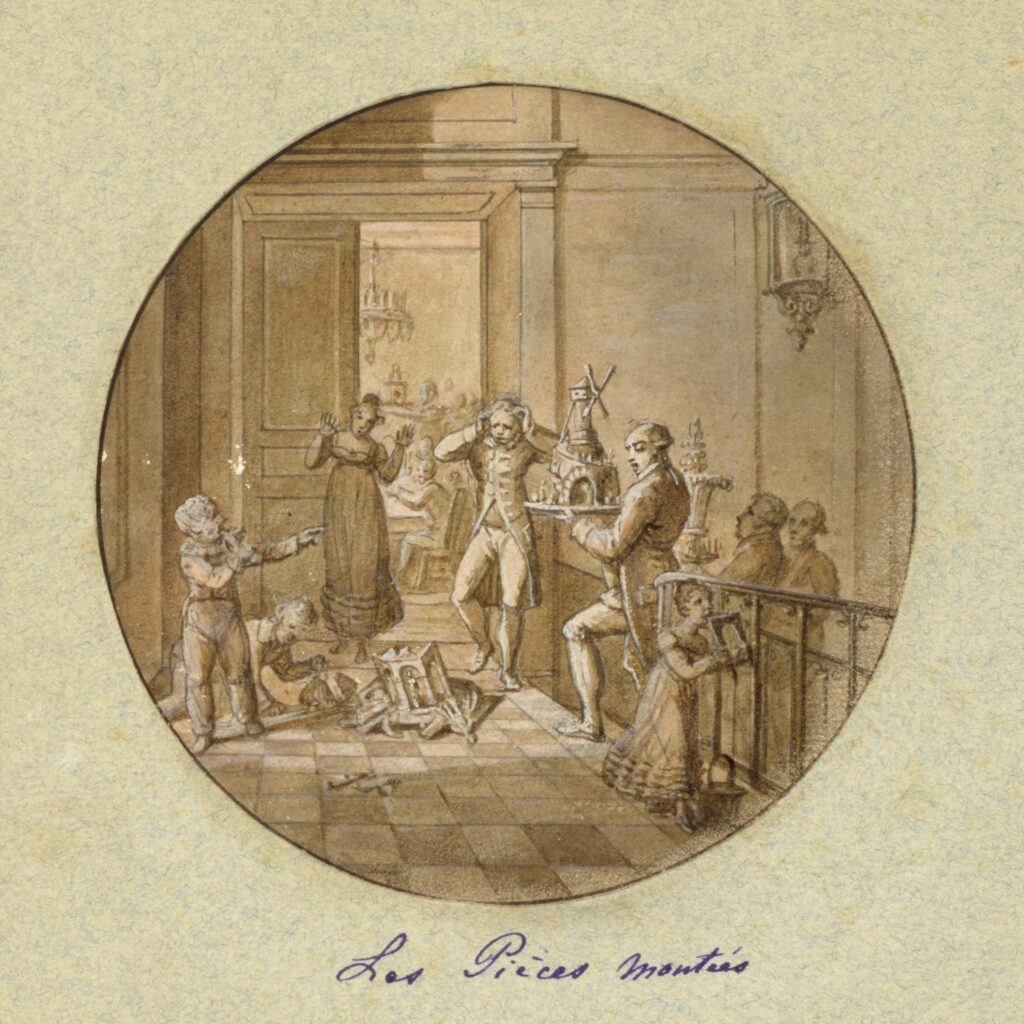
At first glance, the Black man’s presence appears to be a device on the part of Jean Charles Develly to link the sugared delicacies of the dessert service to sugar’s violent origins. Yet the man’s neatly tailored dress and tidy surroundings suggest the location of the scene is not just a confectioner’s shop but a well-to-do boutique in metropolitan France. Although we do not know the man’s free or enslaved status—slavery would not be abolished in the French empire until 1848—we may conjecture that he is a confectioner in his own right. Indeed, Develly’s design is testament to the little-known history of enslaved confectioners on both sides of the Atlantic.
Given that professionals trained in the delicate art of confectionary were hard to come by in the Americas, it became a symbol of affluence and cultural refinement to send an enslaved person to France for training. The most cited example is that of James Hemings, Thomas Jefferson’s enslaved chef who accompanied him to France from 1784 to 1789. Although Hemings’ culinary training has been well studied by historians, particularly in relation to Jefferson’s own admiration of French culture and cuisine, Hemings’ knowledge of the confectionary arts has been largely sidelined.[1] After completing his culinary studies, Hemings divided his time between Paris and Chantilly, where he studied confectionary in the kitchen of Louis Joseph, the Prince of Condé.[2]
Less is known about confectioners—enslaved or free, Black or white—in Saint-Domingue, and the French Antilles more broadly. What is clear is that in the wake of the Seven Years’ War, as colonial elites in Saint-Domingue aimed to emphasize their cultural and racial affinity with the metropole, confectioners existed in increasing numbers.[3] The inventory of the mixed-race indigo plantation owner Julien Raimond records, among his many possessions for the dining table, an enslaved individual who had been trained as a pastry chef.[4] Raimond’s well-set dining table served as a physical and cultural manifestation of his good taste, and, by extension, his whiteness.[5] Indeed, it was not until the 1770s, when increasingly harsh legal definitions of biological race were instated in the colony, that Julien Raimond’s whiteness was revoked and he was re-categorized in legal documents as a “quarteron.”[6] The term indicated Raimond was a person of color and, more specifically, that one of his four grandparents was of African descent.
Plantation owning families deemed suitably white aimed to distance themselves from mixed-race, white-passing elites such as Julien Raimond. Yet even their whiteness was called into question upon travel to metropolitan France. Although they were considered to be at the top of the racial and class hierarchy in Saint-Domingue, in France white Creoles were socially tainted by their immediate proximity to Blackness. Subscribing to an intricately constructed culture of taste—one in which the material culture and performance of dining factored predominantly—was but one strategy of assimilation.[7] The patronage of sumptuous sculptural confections transposed the most exalted dining customs of Paris into the public and private spaces of the Creole plantation class. Pièces montées and white sugar-paste pastillage figurines depicting pastoral, chinoiserie, and antique subjects became a way for colonial government officials and plantation owners alike to celebrate and demonstrate their affinity to a white Parisian elite.[8] Although no images of the colonial table survive, the French confectioner Joseph Gilliers’s manual on the dessert course documents for posterity such elaborate sculptural constructions (Fig. 3).

The Parisian confectioner’s most impressive architectural and sculptural works were made from sucre royale, the whitest of all types of sugar and refined exclusively in France. Yet the market for sucre royale, which was prohibitively expensive and made from the highest quality raw materials, was limited to Paris and Versailles. To my knowledge, French refiners did not ship the rarefied commodity back to the colonies for sale. As such, it is very likely that confectioners and refiners in Saint-Domingue, like many of their metropolitan French counterparts, fabricated sucre terré, a “lesser” refined sugar, to appear as white, transparent, and crystalline as sucre royale.[9] In doing so, they would have played directly into the hands of French refiners, customs agents, and consumers whose increasing anxiety regarding the “purity” and authenticity of sugar coming from Saint-Domingue mirrored similar fears that the French would become a race of sang-mêlés (“mixed-bloods”).[10]
Nevertheless, the commitment to metropolitan French banqueting traditions—and its attendant associations with an increasingly rigid understanding of racialized whiteness—is evident throughout the pages of Saint-Domingue’s first commercial broadsheet, the Affiches américaines. In 1773, the confectioner and distiller Sieur Blenon advertised a recent shipment of goods received directly from France, which included “the latest and most fashionable surtouts [centerpieces], which he will display fully decorated in his shop a few days before and after New Year’s Day.”[11] In 1780, the confectioners Sieurs Blanc & Courrieradvertised the saleof biscuits coming directly from the Palais Royal in Paris.[12]
Most notable is the 1771 inventory sale of the Cap-Français boutique of the confectioner Sieur Bonnefond, located on the Rue Penthievre.[13] Conducted in preparation for his return to France, the inventory details the molds, glasses, and ceramic wares for over 180 table settings. The molds for sugar sculptures included “Chinese subjects, the four seasons in both large and small sizes; a shepherd and shepherdess; sheep and dogs in different poses; architectural features including columns and arches; a fury with her attributes; Venus and Apollo; two satyrs; two dozen smallcupids and shepherds.”[14] In addition to the “various utensils and tools related to confectionary,” the inventory also includes “three Nègres, of which two are excellent confectioners and druggists, & the other, a good cook; also two Négresses, of which one is a good cook, laundress, and governess & the other, a good laundress and seamstress.”[15] We know little of the “three Nègres” and “two Négresses” listed in Bonnefond’s inventory, not even their names. Indeed, most enslaved confectioners in Saint-Domingue survive for posterity as anonymous lines in ledgers. One notable exception was the confectioner la Douceur, or “Sweetness.” Yet even his name effaced his individual identity and conflated him with his labor.[16]
Given the brief description of the two “excellent confectioners” in Bonnefond’s inventory, we can only glean the vaguest contours of their life and art. As confectioners working in Cap-Français, they would have had increased value for a white Creole elite interested in performing Frenchness. This would in turn ensure that the enslaved confectioner was placed in a hierarchy above other enslaved individuals in Cap-François, and certainly above the enslaved plantation field hand in rural Saint-Domingue. In terms of their artistry, we can only speculate that they had a hand in constructing and filling the molds of Venus and Apollo, of chinoiserie subjects, of delightful animals, with a white sugar pastillage. We can only imagine that the 180 place settings that they likely had a hand in making and maintaining were those cited in a description of a 1769 banquet held by the Fathers of Charity in Cap-Français: “For lunch and dinner [the Fathers] built a rustic salon champêtre, artistically made, ornamented with greenery and flowers and very well illuminated, in which they set up a table with one hundred place settings. We saw a shell grotto in a hollow, in the middle of which was a fountain seven to eight feet tall […]”[17] Such a centerpiece fountain would have been a feat of great proportions, particularly in the Caribbean heat. It would have required a highly skilled confectioner trained not only in the arts of sugar and pastry, but also in paper mâché, porcelain, and other materials used in the fabrication of ephemeral architecture.
Certainly, the ideological significance of sugar sculptures—often displays of political and princely power in early modern Europe—shifted when made by enslaved confectioners and displayed in such proximity to the locus of sugarcane’s agricultural origins.[18] Without the temporal and geographic distance proffered by the Atlantic Ocean, the confectioners’ art was explicitly implicated in the brutality of the sugar plantation. I would go so far as to suggest that visually and physically consuming figural sugar in Saint-Domingue was a form of cannibalism.[19] The very charge that Europeans placed on Africans and indigenous Caribs to justify their enslavement, cannibalism metaphorically underwrote the Caribbean slave economy through daily acts of violence in which the Black body was objectified and consumed.[20] Writing in the English tradition, Olaudah Equiano stated as much in his famous description of the Middle Passage: “I asked them if we were not to be eaten by those white men with horrible looks, red faces, and long hair?”[21] The English abolitionist William Fox cited an unknown French writer who had observed “that he cannot look on a piece of sugar without conceiving it stained with spots of human blood.”[22]
As Doris Garraway has illustrated, French colonial rhetoric surrounding cannibalism was laden with desire for the racial other. The missionary Jean-Baptiste Du Tertre imagined his own cannibalism at the hands of the Caribs in terms that displace the fantasy of colonial desire onto the abject. French flesh, Du Tertre claims to have heard, was “the best and the most delicate.”[23] The desire for and consumption of the “delicate” art of sugar sculpture and pastry thus makes explicit the politics of sugar consumption not just on Saint-Domingue, but across the Atlantic as well.[24] Recalling the enslaved confectioner la Douceur, the desire for sugar is transcribed onto his body. Whether sexual or gustatorial in meaning, his name suggests that he too is sweet and ripe for consumption. Indeed, the spots of human blood imagined by the anonymous French writer were not only cannibalistic; they were illustrative of what the practice of sugar sculpture and increasingly rigid colonial laws of racial segregation could not avoid. Saint-Domingue’s increasingly mixed-race society was the result of cross-racial sexual desire, the truth of which could not be sugarcoated or effaced.
It is tempting to return to Develly’s Sèvres plate of 1830 as a tidy resolution to the unsettling cannibalistic violence of the confectionary arts. The elegant rendering of the Black confectioner illustrates a fantasy of progress, in which the enslaved fieldworker has become the confectioner, and the enslaved confectioner has become his own master. But as Saidiya Hartman reminds us, “the loss of stories sharpens the hunger for them. So it is tempting to fill in the gaps and to provide closure where there is none.”[25] Develly’s plate is such a fiction.
[1] A notable exception is Annette Gordon-Reed, The Hemingses of Monticello: An American Family (W.W. Norton & Company, 2008), 155-209.
[2] Gordon-Reed, The Hemingses of Monticello, 156-66.
[3] Jennifer L. Palmer, Intimate Bonds: Family and Slavery in the French Atlantic (University of Pennsylvania Press, 2016), 27.
[4] John D. Garrigus, Before Haiti: Race and Citizenship in French Saint-Domingue (Palgrave Macmillan, 2006), 1-8.
[5] On the relationship between taste and Creole racial hierarchies in Saint-Domingue, see Madeline L. Zehnder, “Revolutions of Taste: Mon Odyssée and the Aesthetic Inheritance of Saint-Domingue,” American Literary History 31, no. 1 (2019): 1–23.
[6] Humiliated by this change in circumstances, Raimond returned to France in the 1780s to advocate for racial reform (notably not abolition) in the colonies. Florence Gauthier, L’aristocratie de l’épiderme: Le combat de la Société des Citoyens de Couleur, 1789-1791 (CNRS Editions, 2007), 21-31. On the legal evolution of race in Saint-Domingue in the wake of the Seven Year’s War see, Garrigus, Before Haiti, 110-70.
[7] Simon Gikandi’s theorization on the mutual construction of British ideas on taste, whiteness, and the economic system of Atlantic slavery can be transposed to the French context. Simon Gikandi, Slavery and the Culture of Taste (Princeton University Press, 2011), particularly 80-92.
[8] On the political uses of edible art, see Jérémie Koering, Iconophages: A History of Ingesting Images (Zone Books, 2024), 287-96.
[9] Maud Villeret, Le goût de l’or blanc: le sucre en France au XVIIIe siècle (PU Rennes, 2017), 153-8.
[10] Alicia Caticha, “Material Masquerade: Porcelain, Sugar, and Race on the Eighteenth-Century French Dining Table,” Art History 47, no. 3 (2024): 593-4.
[11] “Le Sr Belnon, Marchand Confiseur & Distillateur, rue Notre-Dame, au Cap, donne avis qu’il a récus de France des Surtouts du dernier goût & des plus à la mode pour garner les tables,” Affiches américaines, 18 décembre 1773.
[12] Affiches américaines, 13 juin 1780. It should be noted that all these confectioners were easily identifiable as “legally white” due to the honorific “Sieur”, which became a signifier of race, rather than class, in the 1770s and further testifies to the increasingly rigid categorization of race in Saint-Domingue after the Seven Years’ War.
[13] Bonnefond’s address is listed in the Affiches américaines, 1 juin 1771.
[14] “180 couverts; un boucaut de moules à figure, pour décorer les desserts; histoires Chinoises; les quatre saisons en grand & en ptit; un berger & une bergère; plusieurs moutons & chines, de différentes attitudes; colones & ceintres; une furie avec ses attributes; Venus & Apollon; deux Satyres, deux douzaines de petits amours & bergers […]” Affiches américaines, 16 janvier 1771.
[15] “[…] toutes sortes d’untensiles relatifs audit état: en outre, trois Negres, dont deux bons Confiseurs & Droguistes, & l’ature, bon Cuisinier; plus, deux Négresses, dont une bonne Confiseuse, Blanchisseuse, & Gouvernante & l’autre, bonne Blanchisseuse & Couturiere.” Affiches américaines, 16 janvier 1771.
[16] Affiches américaines, 16 mai 1789. Another exception is Louis, the confectioner to the former Intendant of Saint-Domingue, M. de Montarcher. Affiches américaines, 25 juin 1774.
[17] Affiches américaines, 21 mars 1770.
[18] On festivals and the ephemeral art of dining in early modern Europe, see Marcia Reed, The Edible Monument: The Art of Food for Festivals (Getty Research Institute, 2015).
[19] My thinking on this subject is informed by Carlyle Van Thompson, Eating the Black Body: Miscegenation as Sexual Consumption in African American Literature and Culture (Peter Lang, 2006).
[20] Although I deploy cannibalism as a metaphor, there are multiple maritime disasters in which the enslaved were known to be cannibalized by their captors. The most famous is documented for posterity in Pierre Viaud, Naufrage et aventures de M. Pierre Viaud, natif de Bordeaux […] histoire veritable vérifiée sur l’attestation de M. Seventeenham, commandant du fort Saint-Marc des Appalaches (Avignon: Offray fils, 1827), 89. Also see Vincent Woodard, The Delectable Negro: Human Consumption and Homoeroticism within U.S. Slave Culture (New York University Press, 2014).
[21] Carl Plasa, “‘Stained with Spots of Human Blood:’ Sugar, Abolition and Cannibalism,” Atlantic Studies 4, no. 2 (2007): 231.
[22] Plasa, “Stained with Spots,” 234.
[23] Doris Garraway, The Libertine Colony: Creolization in the Early French Caribbean (Duke University Press, 2005), 154-5.
[24] Although many sugar sculptures were not intended to be eaten, they nonetheless played with a viewer’s senses, bringing together sight, smell, and taste to create a synesthetic event.
[25] Saidiya Hartman, “Venus in Two Acts,” Small Axe: A Journal of Criticism., no. 26 (2008): 8.
Cite this post as: Alicia Caticha, “Sugarcoating Slavery: Enslaved Confectioners in Saint-Domingue,” Colonial Networks (March 2026), https://www.colonialnetworks.org/?p=958.
Carole Nataf (Courtauld Institute of Art)
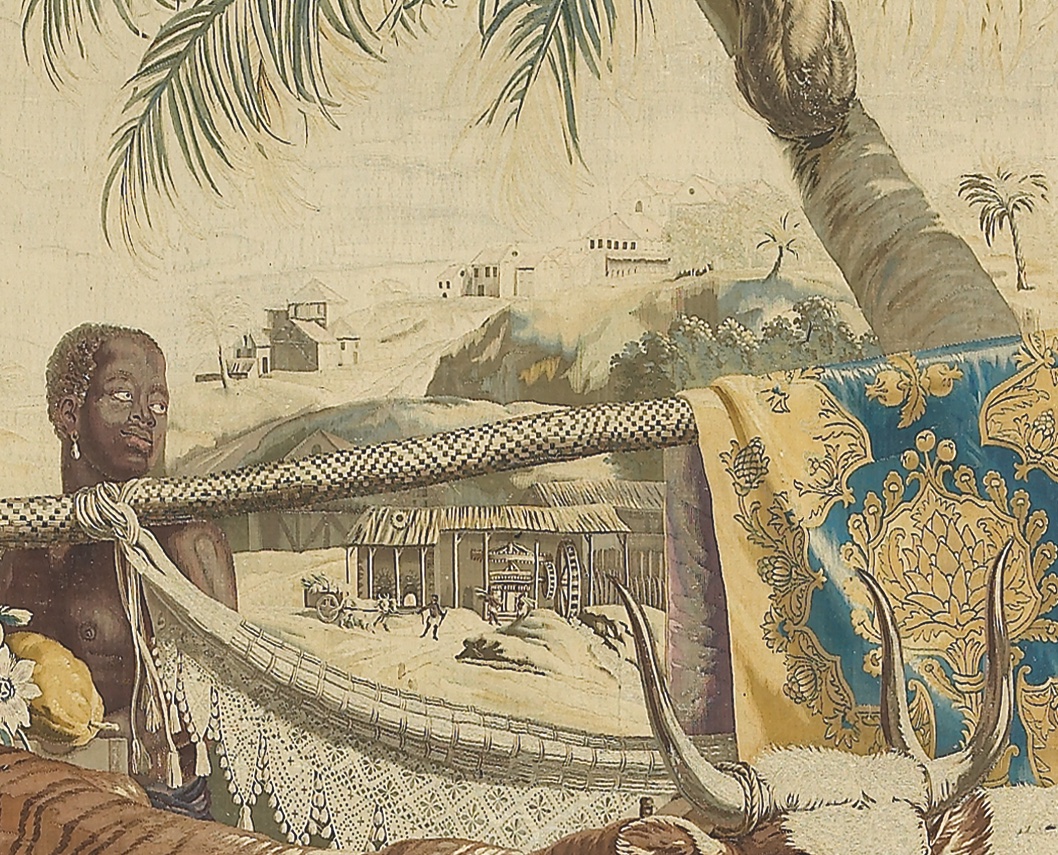
The Gobelins tapestry set known as the Nouvelles Indes ranks among the most spectacular visual representations of colonialism and slavery in eighteenth-century French art. At first glance, the eight Nouvelles Indes tapestries present bountiful visions of fruit-bearing trees, luxuriant vegetation, and the variegated patterns of rearing zebras, pouncing leopards, crawling crustaceans, and leaping fish (Figs. 1–5). Figures crowned with feathered turbans haul fishing nets, while others carry cane baskets, harvest fruit, shoulder palanquins, or wear Kongolese regalia.[1] Les Taureaux, however, lays bare the site these exoticized figures inhabit: a sugar plantation (Fig. 5). Enslaved Black laborers identified by pearl earrings, livestock pulling a loaded cart of freshly harvested sugarcane, and a water-powered sugarcane mill in the background invoke a typical proto-capitalist plantation. These visions of a sugar plantation had originally been recorded by Dutch artists Albert Eckhout and Frans Post between 1637 and 1644 in Dutch Brazil. Their landscapes and studies, gifted in 1679 by Johan Maurits, the former governor of Dutch Brazil, to Louis XIV, served as models for a series of tapestries known as the Anciennes Indes first woven in 1687 by the Gobelins Royal Manufactory.[2] When the Anciennes Indes cartoons (the painted models for weavers) wore out on the Gobelins looms, the French Crown commissioned court painter François Desportes in 1737 to design new cartoons known as the Nouvelles Indes.[3]
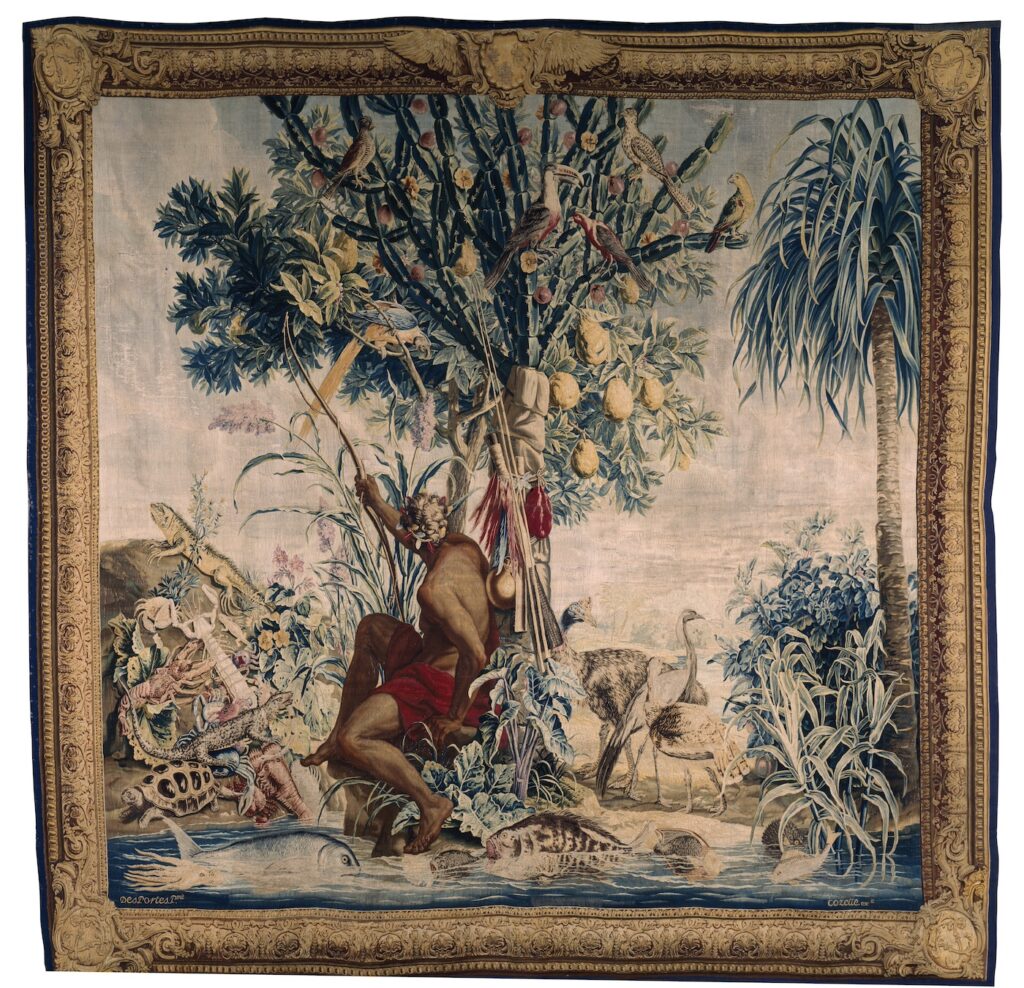
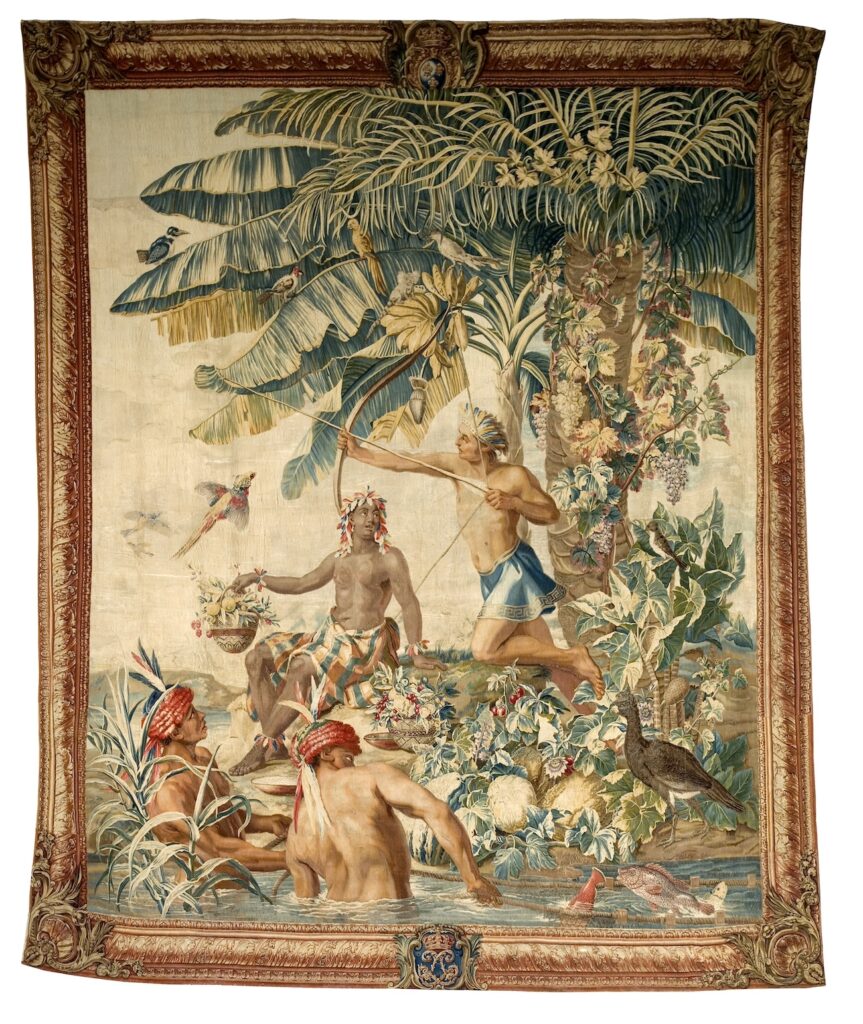
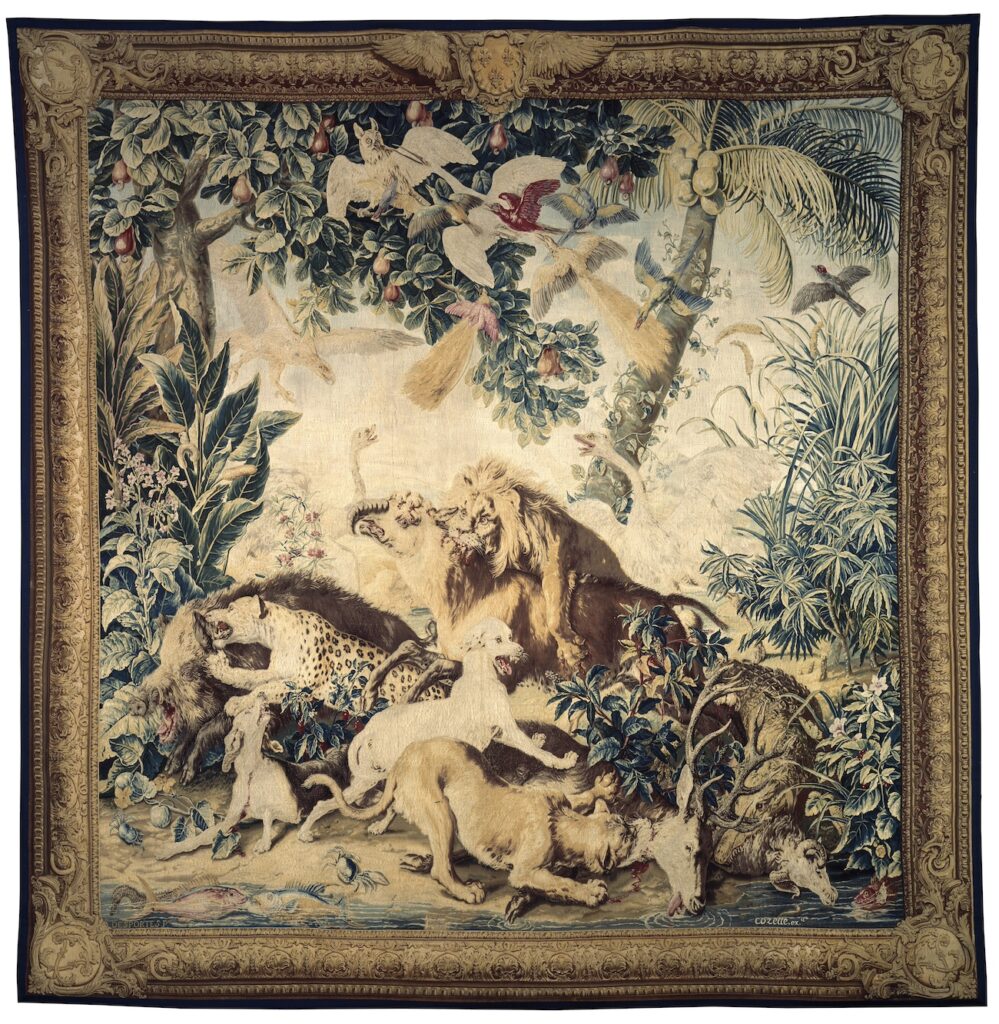
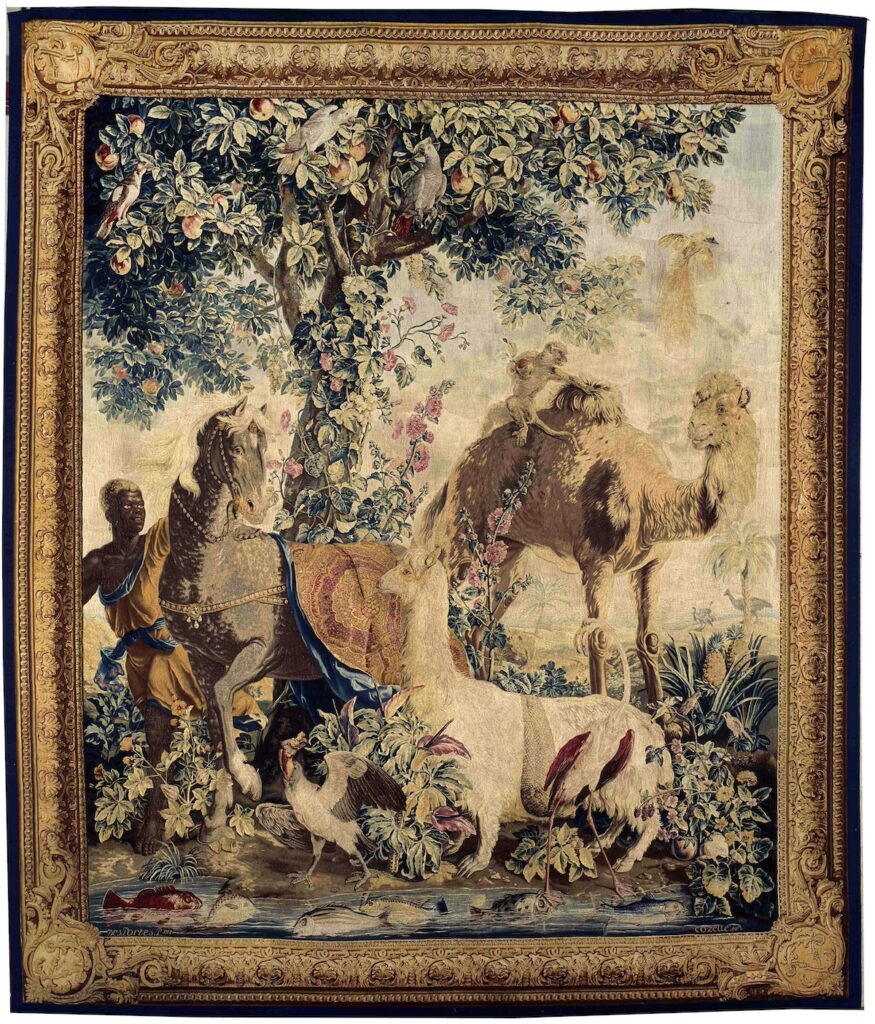
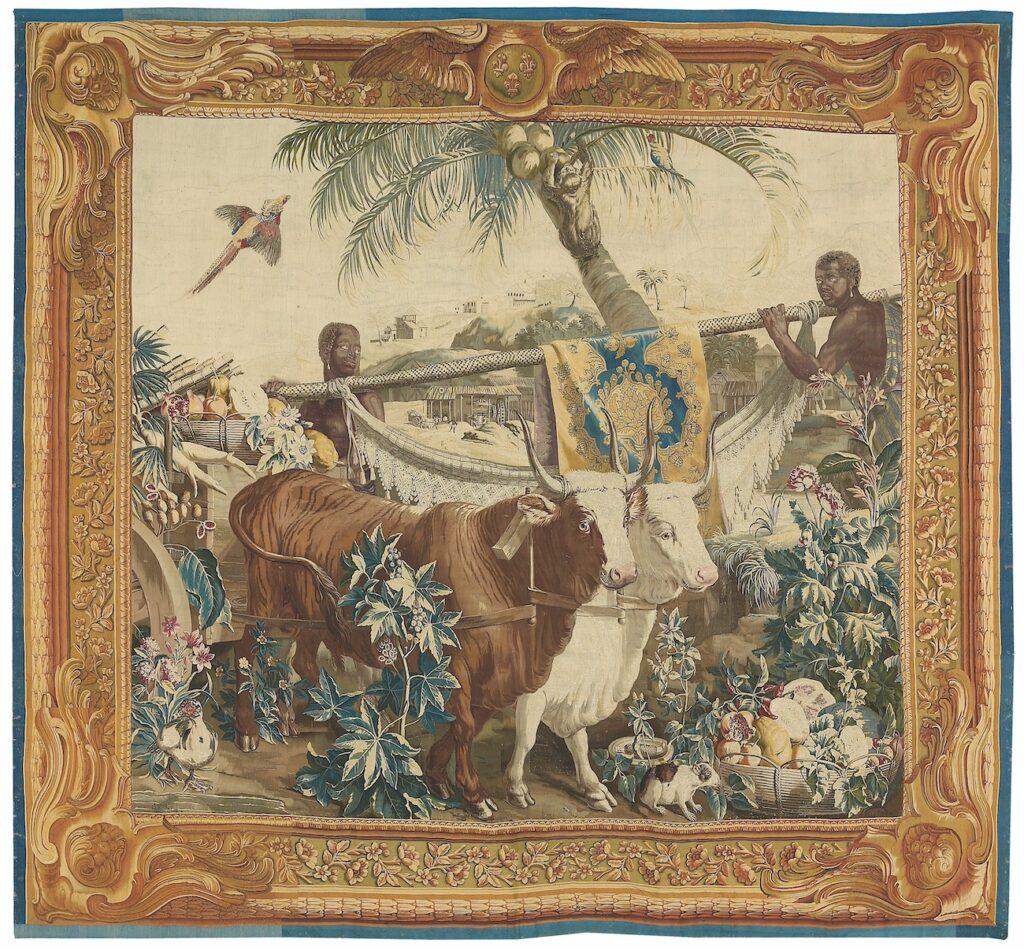
Scholars have generally interpreted Desportes’s Nouvelles Indes as illustrative of a new exotic fashion at the French court.[4] While recent postcolonial interventions have compellingly reframed the Anciennes and Nouvelles Indes as imperial devices that continue to perpetuate erasures in institutions such as the Villa Médicis (Rome) or the Hôtel de la Marine (Paris) today, little attention has been paid to their eighteenth-century owners and historic sites of display.[5] Although the Gobelins Manufactory officially produced tapestries for the state, in the 1760s, financial pressures prompted Gobelins administrators to endorse the regular sale of Nouvelles Indes tapestries languishing in the Garde-Meuble du roi.[6] Recovering the reception of the Nouvelles Indes—who acquired and admired them, and where they were displayed—offers new ways of understanding their meaning and ideological work in the eighteenth century.
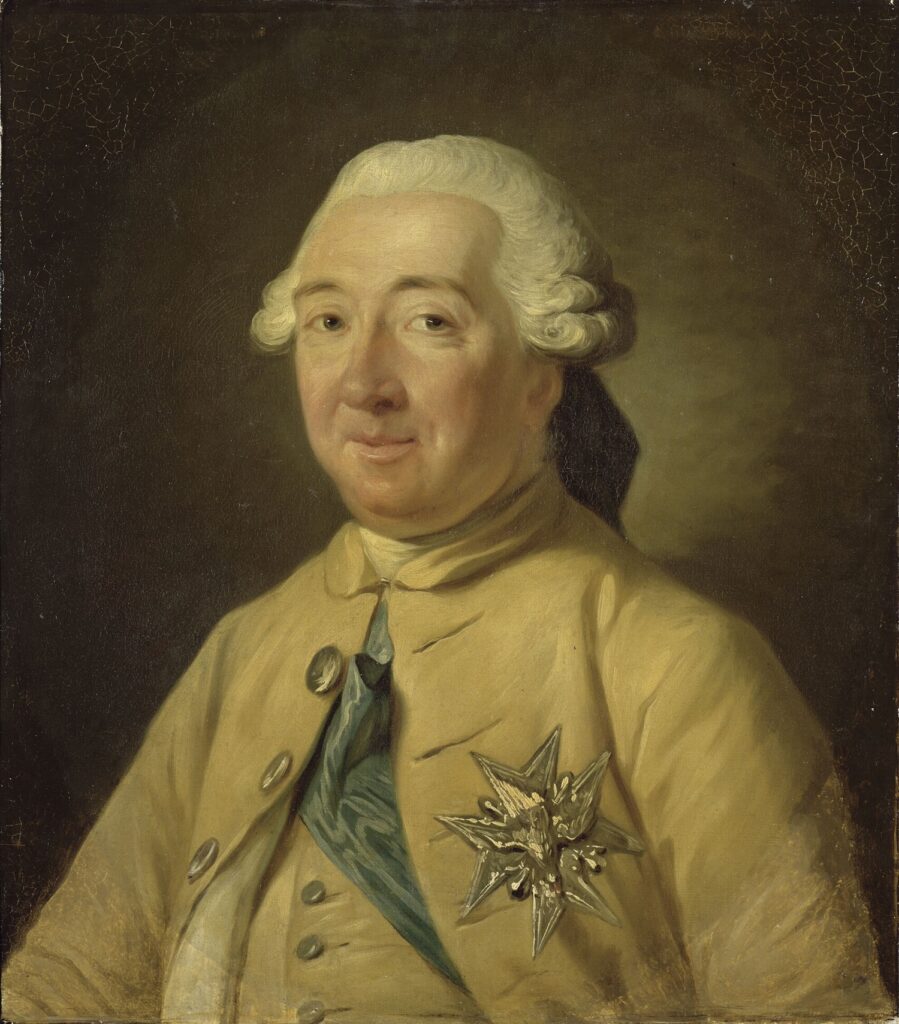
One of the most prestigious owners of the Nouvelles Indes was Louis de Noailles, Duc d’Ayen (1713-1793). On 20 January 1768, he acquired Le Chasseur, Le Chameau, Les Pêcheurs, and Le Combat d’animaux from Monsieur Mériel, the Gobelins manufactory’s silk supplier (Figs. 1-4).[7] As a portrait presenting him wearing the blue sash and the eight-pointed cross of the Order of the Holy Spirit attests, Louis de Noailles stood among the most influential nobles of France, the Noailles family forming a powerful faction at the French court (Fig. 6). Louis was the eldest son of Adrien-Maurice, Maréchal de Noailles, a loyal ally of the king who had distinguished himself in an illustrious military career. After his father’s death in 1766, Louis de Noailles served as governor of Roussillon, governor of the royal houses of Versailles and Marly, and captain of theGardes du Corps.[8]
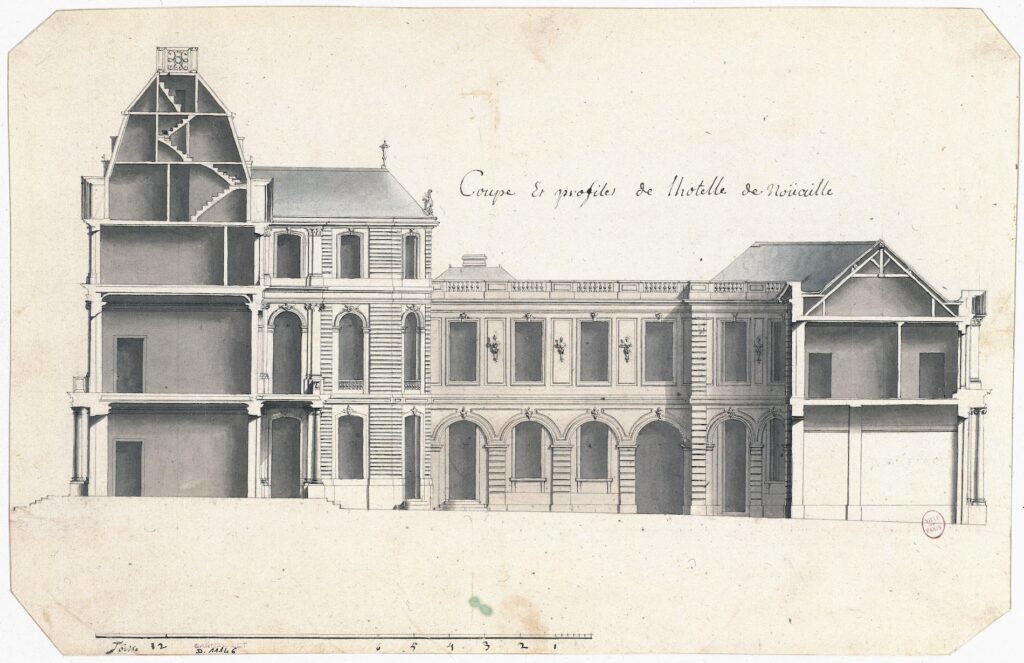
According to the correspondence between Gobelins administrators, Louis de Noailles purchased the Nouvelles Indes to furnish a cabinet in his Parisian hôtel on the fashionable rue Saint-Honoré (Fig. 7).[9] Louis de Noailles had approached Mériel (the Gobelins silk supplier), and Cozette (head of a Gobelins workshop), to ask whether suitable Gobelins pieces remained in store and whether he might obtain them at a reduced price.[10]After considering the measurements of the cabinet’s wall spaces, Le Chasseur, Le Chameau, Les Pêcheurs, and Le Combat d’animaux were deemed the best match. The same quartet had been acquired in 1763 by Lord Tynely, a choice that may reflect the practical advantage of their comparatively narrow widths (unlike the four larger hangings in the series), which were better suited to the proportions of aristocratic interiors.[11] To fit the walls of his cabinet, Louis de Noailles likely removed the original borders of the tapestry. [12]
Although providing no explicit mention of the Nouvelles Indes, the probate inventory drawn up after Louis de Noailles’ death in 1793 nonetheless sheds light on where he displayed and stored Gobelins tapestries at his hôtel. “Cinq pièces de tapisserie des Gobelins représentant différentes vues de châteaux et parties de chasse doublées de toile verte prisée deux cent livres” were recorded as hanging beneath the vestibule of the grand staircase, evoking the Gobelins’ Maisons Royales series.[13] “Onze pieces de tapisserie verdure representant les mois,” likely from the seventeenth-century Gobelins set known as the Mois de Lucas, were kept in storage on the third floor. “Deux autres pieces de tapisserie et verdure l’une, et l’autre des Gobelins” also mentioned in the third-floor storage may refer to Nouvelles Indes tapestries. Verdure tapestries—so called for their dominant greens—typically depicted landscapes and garden views, often populated with exotic animals. Although Gobelins tapestries generally favoured compositions in the grand genre of history painting, the Nouvelles Indes is perhaps the only series that could be described as a verdure.[14]
If the Nouvelles Indes tapestries were selected in part for their dimensions, their subject-matter also resonated sharply with Noailles’ own interests in the Americas. In November 1768, the same year Louis de Noailles purchased the Nouvelles Indes tapestries, the king issued lettres patentes granting him the land concession known as the Îlet du Massacre in the rapidly growing French colony of Saint-Domingue.[15] These lettres patentes renewed an earlier concession made to his father, Adrien-Maurice de Noailles. In 1754, at the request of Adrien-Maurice, and in recognition of his loyal service to the king, Louis XV had granted him the Îlet du Massacre, which would pass after him to his son Louis, and then to his grandson.[16] In keeping with the Crown’s policy of mise en valeur of the French colonies, land was gratuitously ceded on condition that it be cleared, cultivated, and transformed into a productive estate.[17] Adrien-Maurice was thus required to establish an indigo or sugar estate. He would become proprietor of the land on which the plantation operated and was required to divide and sell the remaining land to private settlers.
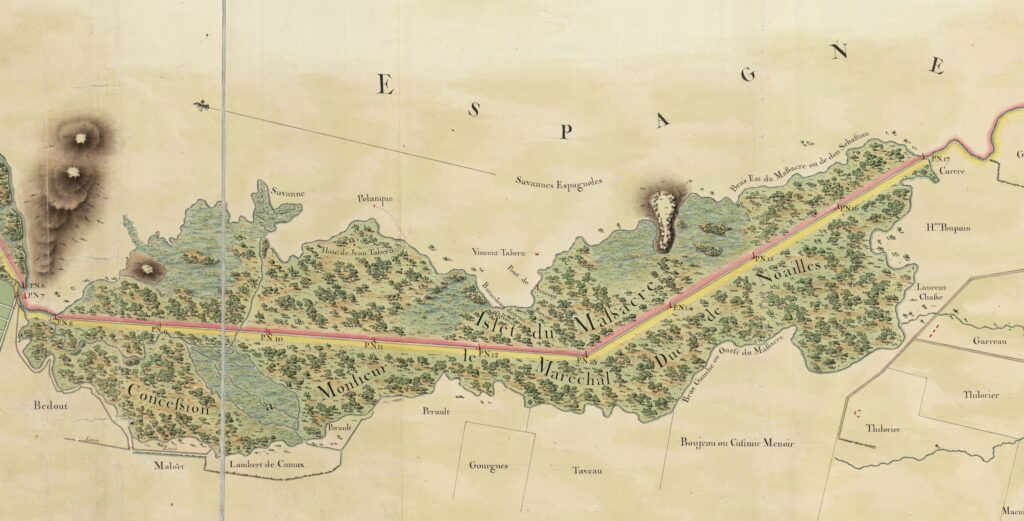
The Îlet du Massacre was located on the northern littoral of the island, at the mouth of the river Massacre near Fort Dauphin. A map of 1776, commissioned by French and Spanish authorities after the signing of the Atalaya treaty to establish clear borders between the French and Spanish colonies along the river, conjures the Îlet’s fertile grounds. It represents the verdant Îlet in a green wash, irrigated by the Massacre and its smaller rivers painted in blue (Fig. 8). Sugar or indigo crops required flat, low-lying land and reliable access to water. In contrast to the neighboring cultivated parcels represented by imbricated pale yellow, green, pink and brown rectangles, the Îlet, populated by lush trees, remained uncultivated. When this map was made, neither Adrien-Maurice nor his son, Louis, had succeeded in establishing the stipulated sugar or indigo plantation. Local governors and intendants of the Windward Islands, having issued small concessions on the Îlet to private individuals, delayed the execution of the 1768 lettres patentes in favor of Louis de Noailles.[18] The concession was also an unstable territory, straddling the contested frontier between the French and Spanish colonies.[19] After the 1776–77 Franco-Spanish agreement divided the Îlet du Massacre roughly in half, the king reaffirmed that the remaining French portion belonged to Louis de Noailles, for the establishment of an indigo or sugar plantation.[20] On the map, the yellow and red lines cutting across the Îlet du Massacre materialize the French and Spanish borders. Only the southern French half is marked as “Concession à Monsieur le Maréchal Duc de Noailles.”
The Noailles family’s engagement with American and Caribbean land and resources was perhaps less abstract or distant than a map might suggest. At his estate at Saint-Germain-en-Laye, Louis de Noailles cultivated one of the most expansive botanical gardens in France, acclimatizing American species procured through a network of scientific correspondents in Philadelphia and regular exchanges with eminent naturalists.[21] He also experimented with sugarcane cultivation in greenhouses on the estate: 250 pots containing banana trees and sugarcanes were recorded there in his probate inventory.[22] In designing botanical gardens for Louis XV at Trianon, moreover, he worked closely with botanist Michel Adanson, who had conducted extensive research on indigo in Senegal.[23]
In linking Noailles’ ownership of the Nouvelles Indes tapestries to the land he was given in the French colony of Saint-Domingue, my aim is not to propose a causal explanation, whereby Louis de Noailles’ colonial possessions explain his taste for the Nouvelles Indes. Rather, the connection sharpens our reading of these tapestries, not as innocuous fantasies of faraway abundance, but as visual expressions that were structurally linked to the colonial machine and the institution of slavery.[24] Tracing the connections between royal tapestries and Caribbean plantations exposes the interdependency between the culture of taste prevalent in aristocratic Parisian interiors and the violence of slavery in colonial territories upon which it depended, two worlds too often treated as separate.[25] From this perspective, the apparent fancifulness of the Nouvelles Indes can be read not as ignorance of colonial realities, but as a going hand in hand with the administration and exploitation of colonial land.
[1] Cécile Fromont has identified the figure as one of the three Christian ambassadors of the Kingdom of Kongo sent in 1642 to Brazil (Miguel de Castro, Bastião de Sonho, and António Fernandes), whose identity was progressively erased in French royal property inventories. Cécile Fromont, The Art of Conversion: Christian Visual Culture in the Kingdom of Kongo (Williamsburg, 2014), 116; Cécile Fromont, “Kongo, Brésil, France et colonies : les enjeux du visible et de l’invisible dans la Tenture des Indes de la Villa Médicis”, in Esclavages, Représentations visuelles et cultures matérielles (Atlantique-océan Indien), ed. Ana Lucia Araujo, Klara Boyer-Rossol and Myriam Cottias (CNRS Éditions, 2024), 105-40.
[2] Rebecca Parker Brienen, Visions of Savage Paradise: Albert Eckhout, Court Painter in Colonial Dutch Brazil (Amsterdam University Press, 2006), 32–34; Carrie Anderson, “The Old Indies at the French Court: Johan Maurits’s Gift to Louis XIV,” Early Modern Low Countries 3, no. 1 (2019): 32–59; Michael Benisovich, “The History of the Tenture Des Indes,” The Burlington Magazine for Connoisseurs 83, no. 486 (1943): 210–225.
[3] Georges de Lastic Saint Jal and Pierre Jacky, Desportes (Monelle Hayot, 2010), 244.
[4] Marianne Roland Michel, “Représentations de l’exotisme dans la peinture en France de la première moitié du XVIIIème siècle,” Studies on Voltaire and the eighteenth century 151–152 (1976): 1448; Jacky and Lastic, Desportes, 258–259. See also Jean Vittet, Les Gobelins au siècle des Lumières: un âge d’or de la manufacture royale (Swan, 2014), 163–173; Madeleine Jarry, “L’exotisme au temps de Louis XIV: tapisseries des Gobelins et de Beauvais,” Medizinhistorisches Journal 11, no. 1/2 (1976): 52–71; and Helga Prüssmann-Zemper, “Exotische Welten im Spiegel der Sprache. Linguistische Anmerkungen zu Indes, calecuttisch, Maures,” in Exotismus und Globalisierung : Brasilien auf Wandteppichen : die Tenture des Indes, ed. Gerlinde Klatte, Helga Prüssmann-Zemper, and Katharina Schmidt-Loske (Deutscher Kunstverlag, 2016), 25–35.
[5] “La Tenture des Indes. À la croisée des regards historiques et artistiques,” Académie de France à Rome–Villa Médicis, Journée d’étude, 30 septembre 2021; Regards sur les Tentures des anciennes Indes du grand salon de la Villa Médicis, Carte Blanche, Sammy Baloji, Anne Lafont and Cécile Fromont (Institut d’études avancées de Paris, 2021), https://www.youtube.com/watch?v=fTa1gt_bqq4; Cécile Fromont, “Kongo, Brésil, France et colonies : les enjeux du visible et de l’invisible dans la Tenture des Indes de la Villa Médicis,” in Esclavages, ed. Ana Lucia Araujo, Klara Boyer-Rossol, and Myriam Cottias (Paris, 2024), 105–140. An exhibition presenting Sammy Baloji’s work also offered a critical reframing of four of the Nouvelles Indes tapestries. See “Sammy Baloji– K(C)ongo, Fragments of Interlaced Dialogues,” Paris, École des beaux-arts, 10 June–18 July 2021. For a comparative review of the Baloji exhibition with part of a set exhibited at the Hôtel de la Marine, see Meredith Martin, “Left Bank/Right Bank: Two Views of the ‘Indies’ in Paris,” Journal18 (2021). On the Nouvelles Indes, see Carole Nataf, “Rococo Enlightenment: Art, Decoration, and Science in Eighteenth-Century France and its Empire” (PhD dissertation, Courtauld Institute of Art, 2025), 49-104.
[6] See the correspondence between Jacques-Germain Soufflot and the Marquis de Marigny in Jean Mondain-Mouval, Correspondance de Soufflot avec les directeurs des bâtiments concernant la Manufacture des Gobelins (1756–1780) (Paris, 1918), 163, 213, 245.
[7] Fenaille, État général des tapisseries, vol. 2, 58-59; Archives Nationales, O/1/2046, February 1, 1768; Archives Nationales, F/12/639/A.
[8] Peter Robert Campbell, Power and Politics in Old Regime France, 1720-1745 (Routledge, 1996), 168.
[9] Archives Nationales O/1/1554, January 31, 1768, Letter from Soufflot to Marigny, reproduced in Mondain-Mouval, Correspondance de Soufflot, 212-213.
[10] Ibid.
[11] For measurements, see Fenaille, État général des tapisseries, 51.
[12]AN/O/1/1554, January 31, 1768, Letter from Soufflot to Marigny, reproduced in Mondain-Mouval, Correspondance de Soufflot, 213. See also Fenaille, État général des tapisseries, 59.
[13] Archives Nationales, MC/ET/LXXI/119, “Inventaire après décès de Louis de Noailles, décédé le 22 août 1793 à Saint-Germain-en-Laye, à la requête de Catherine Françoise Charlotte de Cossé de Brissac, sa veuve, demeurant rue Saint-Honoré, section des Tuileries.28 brumaire an II (18 novembre 1793),” entry 143.
[14] The Aubusson Manufactory, rather than the Gobelins, specialized in exotic verdures produced for the market.
[15] The Îlet took its name from the river Massacre (today the Dajabón river), itself named after a 1728 event in which Spanish settlers killed French buccaneers.
[16] ANOM, COL A 6 F. 68, Mai 1754.
[17] Éric De Mari, “Des devoirs du concessionnaire aux droits du propriétaire: le cas de Saint-Domingue (XVIIe– XVIIIe siècle),” in L’empire de la propriété : L’impact environnemental de la norme en milieu contraint III. Exemples de droit colonial et analogies contemporaines, ed. Éric De Mari and Dominique Taurisson-Mouret (Victoires éditions, 2016), 113.
[18] ANOM, COL A 16 F.223, Mars 1778.
[19] Jean-Louis Glénisson, “La question des limites des colonies française et espagnole de Saint-Domingue et la carte de la frontière (1776),” Le Monde des Cartes, 187 (2006): 81.
[20] ANOM, COL A 16 F.223, Mars 1778.
[21] Elizabeth Hyde, “‘A Reciprocal Exchange of the Productions of Nature’: Plants and Place in France and America,” Huntington Library Quarterly 84, no. 3 (2021): 593.
[22] Archives Départementales des Yvelines, 3E 38, 145, Saint-Germain-en-Laye, ét. Denis Odiot de Lardilière, “Inventaire après le décès du Citoyen Louis de Noailles, 16 décembre 1793” as quoted in Gabriela Lamy, “Des Jardins de Saint-Germain aux Jardins de Trianon,” in Une maison de plaisance au XVIIIe siècle l’hôtel de Noailles à Saint-Germain-en-Laye, ed. Françoise Brissard et Gabriel Wick (Artlys, 2016), 107.
[23] Roger L. Williams, “On the establishment of the principal gardens of botany: A bibliographical essay by Jean-Philippe-François Deleuze,” Huntia 14, no. 2 (2011): 167; Françoise Brissard and Louis-Joseph Lamborot, “L’évolution d’un jardin aristocratique au XVIIIe siècle éclairé par sa restitution numérique: le cas de l’hôtel de Noailles à Saint-Germain-en-Laye,” in Les maisons de plaisance des environs de Paris du Grand Siècle au Second Empire, ed. Anaïs Bornet and Francesco Guidoboni (Artemide, 2023), 191–192; Mary Terrall, “African Indigo in the French Atlantic: Michel Adanson’s Encounter with Senegal,” Isis 114 (1) (2023): 2-24.
[24] On the structural link between the culture of taste and slavery and systematic acts of exclusion, see Simon Gikandi, Slavery and the Culture of Taste (Princeton University Press, 2014), 37.
[25] On this structural dependence, see Gikandi, Slavery and the Culture of Taste.
Cite this post as: Carole Nataf, “Land and Loom: Louis de Noailles’ Nouvelles Indes Tapestries,” Colonial Networks (February 2026), https://www.colonialnetworks.org/?p=941.
Amanda Maffei (Università degli Studi di Milano and Institut Catholique de Paris)
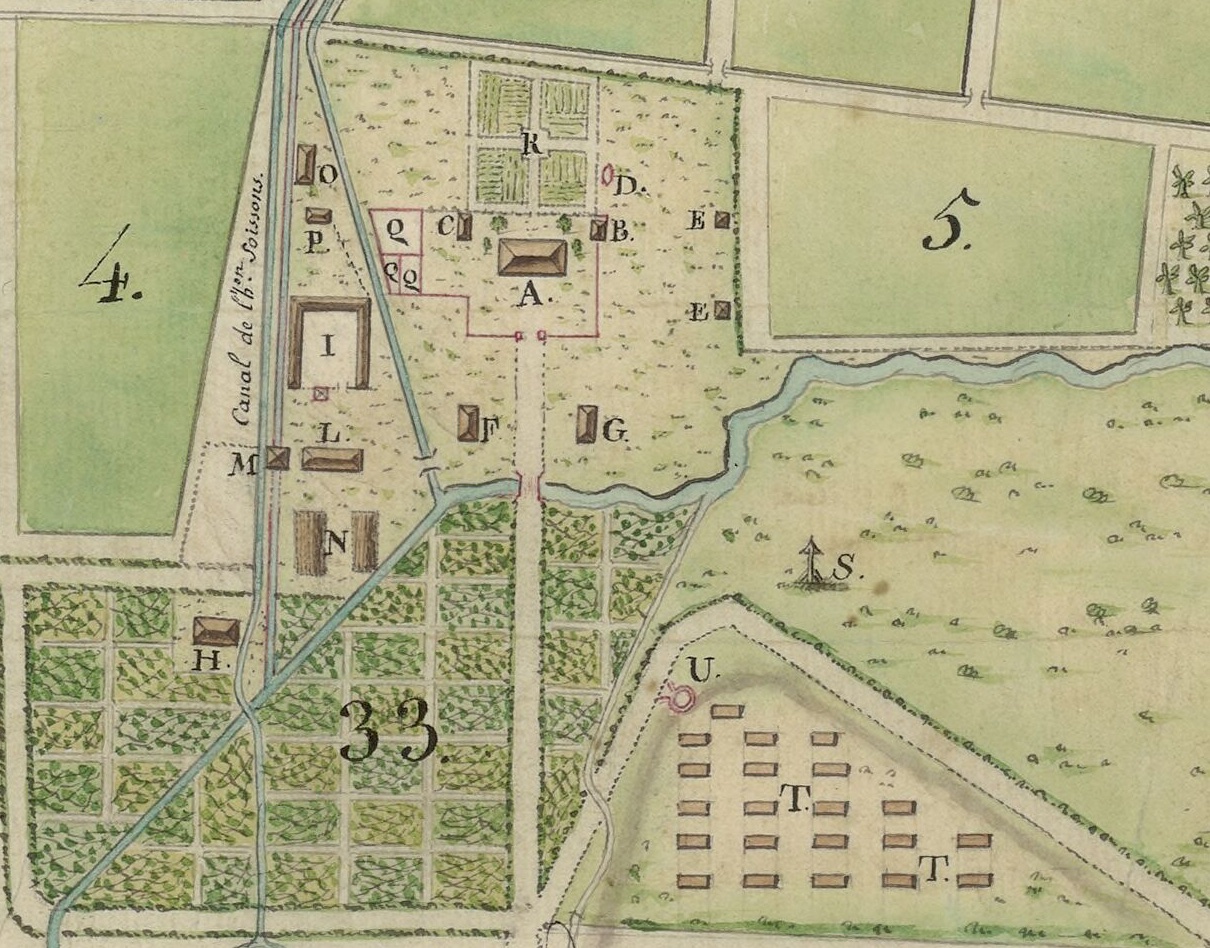
Maps and other images associated with the family of Jean-Charles and Marc-René de Montalembert offer an unusually clear window onto the visual culture that connected Enlightenment Paris and colonial Saint-Domingue in the final decades of the eighteenth century.[1] At once noble, technical, and deeply visual, the Montalembert family inhabited two worlds: an hôtel particulier in the Faubourg Saint-Antoine, and a series of plantations in the fertile Cul-de-Sac plain near Port-au-Prince. The forms of these distant properties mirrored one another with striking precision (Figs. 1 and 2).[2] Their story reveals how a single aesthetic language, built on geometry, symmetry, and the authority of the eye, could travel across the Atlantic, shaping both metropolitan and colonial environments before unraveling in the age of revolutions.[3]
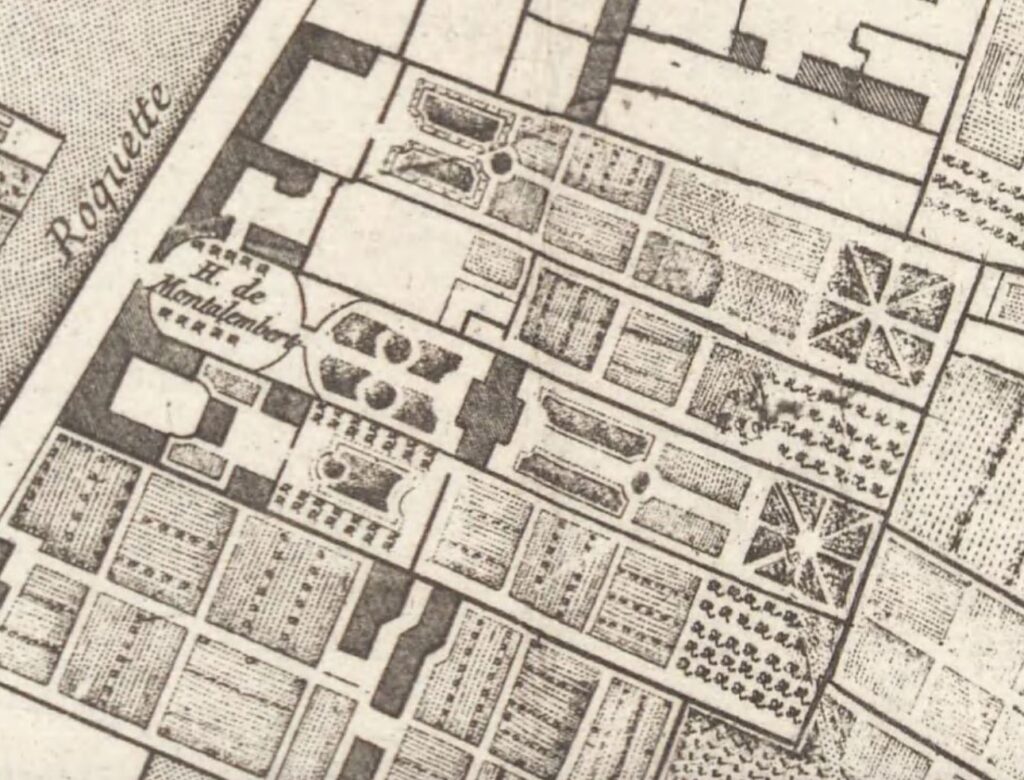
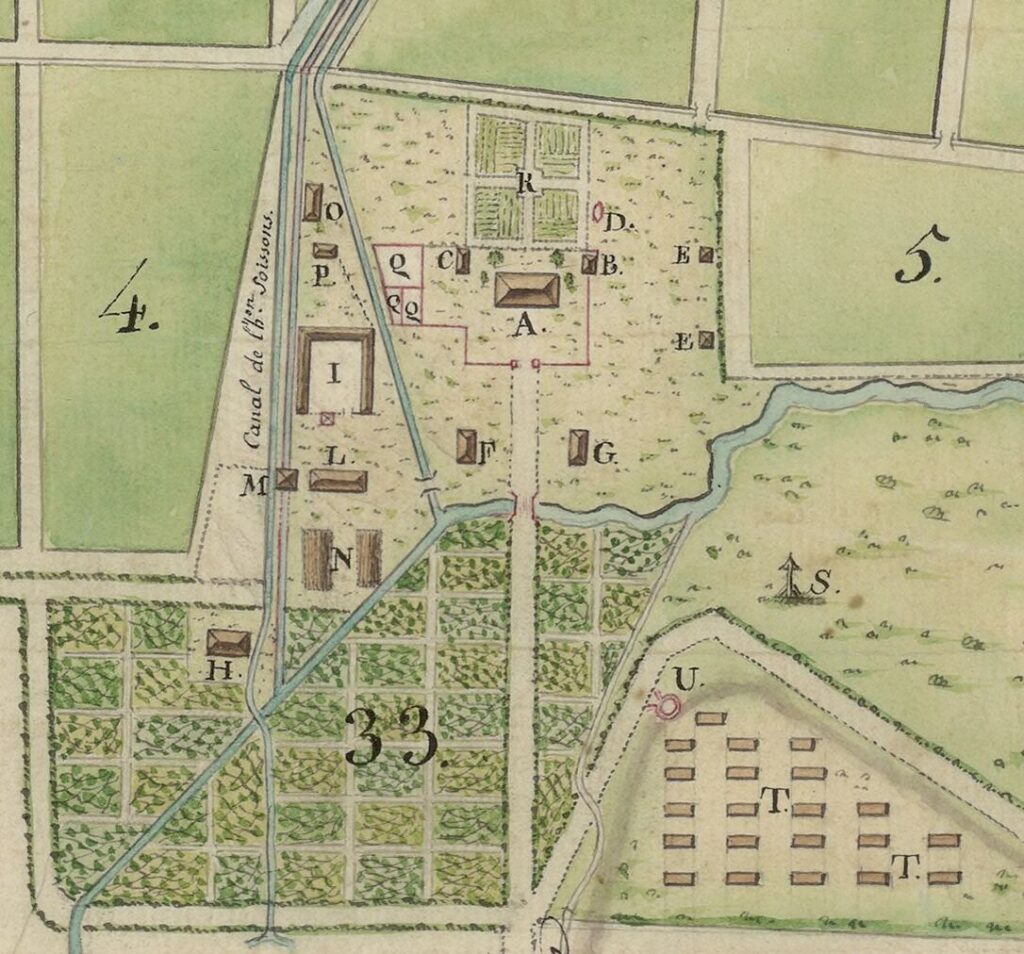
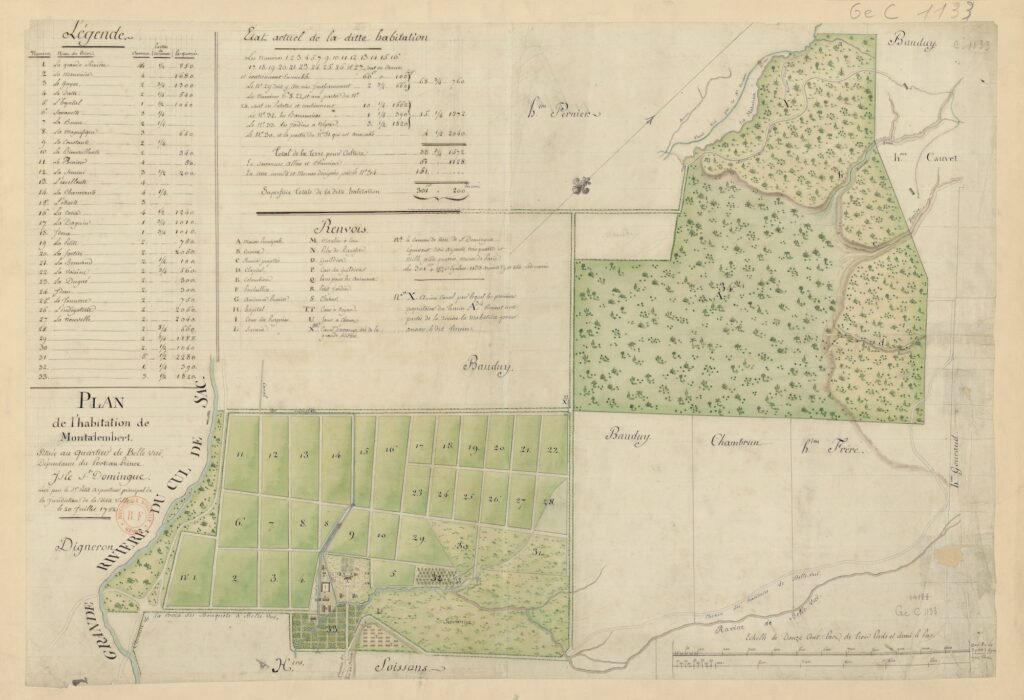
Marc-René de Montalembert, a military engineer and theorist of fortifications, and his nephew Jean-Charles, an officer of the marine infantry, belonged to an aristocracy that redefined itself through colonial investment. By the 1780s, the family managed large sugar estates in Saint-Domingue through detailed maps, correspondence, and the work of professional surveyors.[4] Their Paris house, meanwhile, stood as an emblem of rational domestic order: a symmetrical façade, a circular vestibule, and a formal garden extending toward the present location of Père-Lachaise. This architectural composition found its echo overseas. Both house and plantation expressed the same visual ideal: an ordered space conceived to be seen, measured, and owned (Fig. 3).[5]
For the Montalemberts, vision was a social instrument. It organized the family’s identity as both engineers and proprietors, bridging the realms of art and administration. Their material and visual culture—drawings, models, paintings, and decorative objects—shaped a coherent system of representation that renders the exercise of power as an aesthetic act.
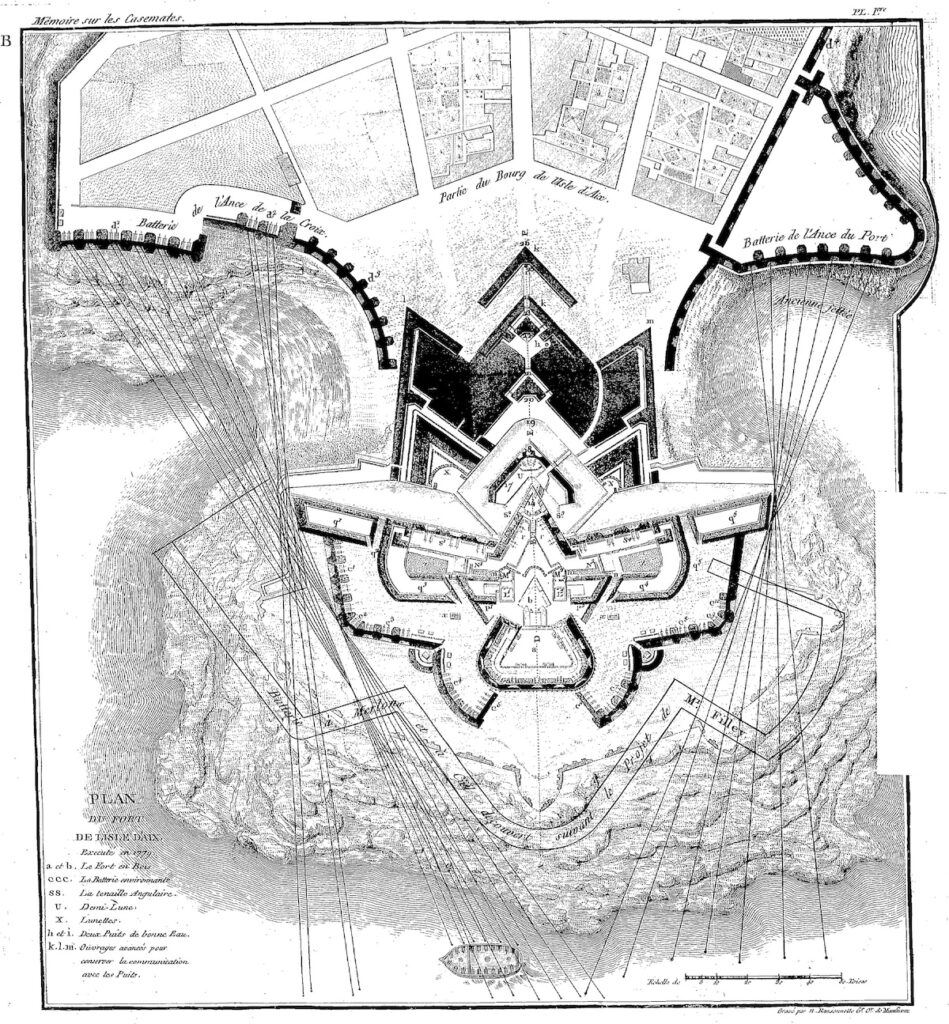
The Montalemberts’ world was shaped by what might be called an aesthetic of measurement: a belief that beauty and reason shared the same geometrical foundation. Marc-René’s cabinet de fortifications, installed in the family’s Paris residence, assembled more than a hundred plans-reliefs and mechanical devices illustrating his theories of “perpendicular fortification.” These intricate models—part scientific apparatus, part visual theater—transformed the art of war into a spectacle of precision (Fig. 4).[6]
Jean-Charles extended this logic to the Caribbean landscape. His plantations in the Savane du Blond were surveyed by the royal engineers Petit and Sonis in 1782 and 1791, producing the plans d’habitation now preserved in the Bibliothèque nationale de France. Each map converts the messy reality of labor and terrain into a perfectly legible design: irrigation canals drawn as elegant arabesques, fields distributed in harmonious sequence, and the owner’s house positioned at the compositional center. In these drawings, geometry functions as a visual guarantee of control. The plantation becomes a rational tableau; its human and natural complexities dissolved into the clarity of line.[7]
This fascination with order extended far beyond engineering. The Montalembert’s artistic world revolved around the same conviction that representation could stabilize reality. In Paris, Jean-Charles and his wife, Marthe-Joséphine de Commarieu, commissioned refined miniatures from Isabey and Jean-Antoine Laurent, while physionotrace engravings by Louis-Gilles Chrétien reproduced their profiles through an early form of mechanical drawing. These portraits, with their precise contours and restrained tonality, materialize the same aesthetic discipline that governed the family’s maps.[8]
Marc-René collected paintings by Claude-Joseph Vernet, whose calm seaports and fortified harbors offered a pictorial parallel to the Montalembert’s geometries of mastery. Vernet’s horizons—half scientific, half theatrical—translated the surveillance of space into art.[9] Around the same time, the watercolor by Du Favry depicting the Hôtel Montalembert and its garden framed the domestic sphere as a perspectival landscape (Fig. 5). The viewer’s gaze moves along the garden axis toward the horizon, as though tracing the invisible line that connects metropolitan order to colonial dominion. Across all these media—maps, portraits, models, paintings, and decorative objects—the act of seeing becomes a form of possession.
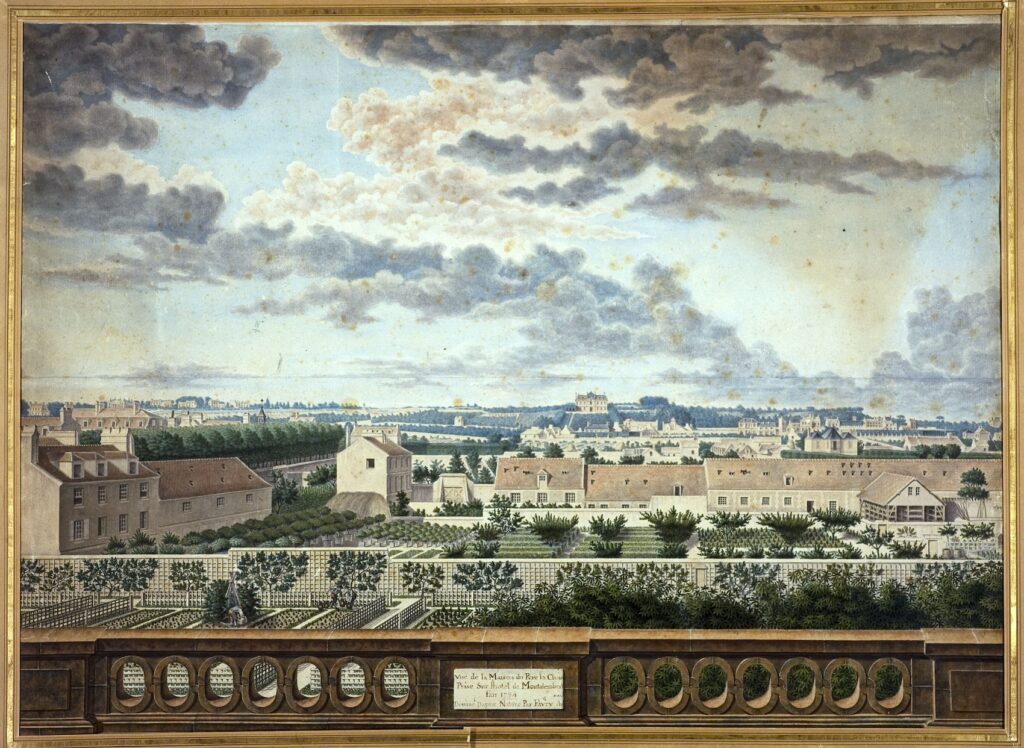
To examine these works today is to recognize their remarkable coherence and their equally remarkable omissions. The plans d’habitation name the owners but not the workers; they depict irrigation systems but not the enslaved and free Black laborers who built and maintained them.[10] Their apparent transparency rests on the systematic abstraction of human presence. The Montalemberts’ vision of beauty depends on this erasure: the conversion of lived space into diagram. Reading such images through a decolonial lens requires acknowledging what they suppress, and imagining the alternative geographies of subsistence, resistance, and community that unfolded beyond the map’s frame.
Yet even in their silence, these objects provide critical evidence of how aesthetic form operated as a tool of empire. They show how artistic and scientific practices merged in the colonial imagination, and how the language of order became indistinguishable from the language of power.
The 1791 plan of the habitation Montalembert-Scépeaux, drawn by the royal surveyor Sonis, later acquired an unexpected function. During the upheavals of the Haitian Revolution, the gérant-procureur Louis Jarossay used this very plan to communicate with Jean-Charles de Montalembert, referring to its numbered sections to describe the “state” of the plantation as he envisioned it.[11] Through the grid of the map he narrated, almost day by day, how the estate was being reorganized after the flight of its white owners: fields replanted, irrigation restored, buildings repurposed.
Crucially, Jarossay’s map-based narration does not end with the loss of colonial control. On the contrary, it is precisely after the plantation falls under the authority of military leaders among the free men of color, allied with enslaved workers, that he continues to mobilize the map as an analytical tool, using its grid to register a new, post-control organization of labor and subsistence. This correspondence transforms the map from a symbol of possession into a tool of observation. What was meant to visualize mastery now recorded survival. The steward’s reports claim that free men of color and enslaved laborers worked together to maintain production, establishing a provisional yet coherent order “from below.” In translating these practices into the language of geometry, the map, in his view, inadvertently preserved a glimpse of mutual cooperation and self-organization—traces of a world that colonial imagery, especially during the uprising of Saint-Domingue, aimed to obscure.[12] While most gérants-procureurs described revolt through formulas of “chaos” and “disorder” meant to demonize Black and mixed-race actors, the Montalembert gérant-procureur’s maps-based account imply social and organizational patterns that the conventional rhetoric of panic would normally erase.
Studying the Montalemberts from an art-historical perspective illuminates the subtle intersections between artistic creation, scientific visualization, and colonial ideology.[13] Their corpus demonstrates that the same visual systems that organized knowledge and space in eighteenth-century France also structured the colonial world overseas. By following their images across media and geography, we can trace how the aesthetics of order functioned as a global technology of power, and how its traces endure in the ways we still value clarity, symmetry, and design.
The Montalemberts remind us that what we call “taste” is never innocent. Their world, suspended between the salon and the plantation, reveals how vision itself became a mode of governance—and how, long after their estates vanished, their images continued to define what was meant to be seen.
[1] There is, to date, no comprehensive study of the Montalembert family; I am currently preparing a full biography. For now, available information relies primarily on the partial biography of Marc-René de Montalembert by Yvon Pierron, Marc-René, marquis de Montalembert (1714-1800). Les illusions perdues (Arléa, 2003).
[2] Information on the Montalembert’s artistic tastes comes from a range of archival and museum collections that are often fragmentary or incomplete. The principal sources include the holdings of the Musée du Louvre, the Musée Carnavalet, the Vernet family papers, the Bibliothèque nationale de France (hereafter BnF), and the Montalembert family’s own private papers.
[3] Geoff Quilley and Dian Kriz, eds., An Economy of Colour: Visual culture and the Atlantic world, 1660-1830 (Manchester University Press, 2003); James A. Delle, The Colonial Caribbean: Landscapes of Power in Jamaica’s Plantation System (Cambridge University Press, 2014); Monica Pretit-Hamard and Philippe Sénéchal, eds., Collections et marché de l’art en France 1789-1848 (Presses Universitaires de Rennes, 2006); Roberta Panzanelli and Monica Pretit-Hamard, eds., La circulation des oeuvres d’art, 1789-1848 (Presses Universitaires de Rennes, 2007).
[4] Montalembert family’s private papers; Sonis, Plan de l’habitation appurtenant par indivis à Messire Jean Charles baron de Montalembert, coloniel de cavalerie, 1791, BnF, https://gallica.bnf.fr/ark:/12148/btv1b53025143x .
[5] For information on the Hôtel Montalembert in the Faubourg Saint-Antoine district of Paris, see Régine de Plinval de Guillebon, “L’ancien hotel Dynoyer, puis Montalembert, Manufacture de porcelain des Frères Darte, rue de la Roquette (11e),” Cahiers de la Rotonde 7 (1984): 19-32.
[6] État des plans en relief qui composent les Cabinets de Fortification de M. le Marquis de Montalembert, à Paris, au mois de Septembre 1783 (Paris, 1783).
[7] Montalembert family’s private papers; Sonis, Plan de l’habitation appurtenant par indivis à Messire Jean Charles baron de Montalembert, 1791, BnF.
[8] René Hennequin, Les portraits au physionotrace gravés de 1788 à 1830: catalogue nominative, biographique et critique illustré des deux premières series (J.-L. Paton, 1932), 82-3.
[9] Léon Lagrange, Joseph Vernet et la peinture au XVIIIe siècle (Paris, Didier, 1864); Charlotte Guichard, “Les écritures ordinaires de Claude-Joseph Vernet: commandes et sociabilité d’un peintre au XVIIIe siècle,” in Jean-Pierre Bardet, Michel Cassan, and François-Joseph Ruggiu, eds., Les écrits du for privé. Object matériels, objets édités (Presses Universitaires de Limoges, 2007), 231-44.
[10] Montalembert family’s private papers; Sonis, Plan de l’habitation appurtenant par indivis à Messire Jean Charles baron de Montalembert, 1791, BnF.
[11] Montalembert family’s private papers, letters from Jarossay dated September-November 1792.
[12] Alejandro E. Gomez, “Images de l’apocalypse des planteurs,” L’Ordinaire des Amériques 215 (2013): http://journals.openedition.org/orda/665 .
[13] James E. McClellan, Colonialism & Science. Saint Domingue in the Old Regime (The University of Chicago Press, 2010).
Cite this post as: Amanda Maffei, “Mapping the Aesthetics of Power: The Montalembert Family between Paris and Saint-Domingue,” Colonial Networks (January 2026), https://www.colonialnetworks.org/?p=930.
Victoria Dickenson (McGill Library and Collections)
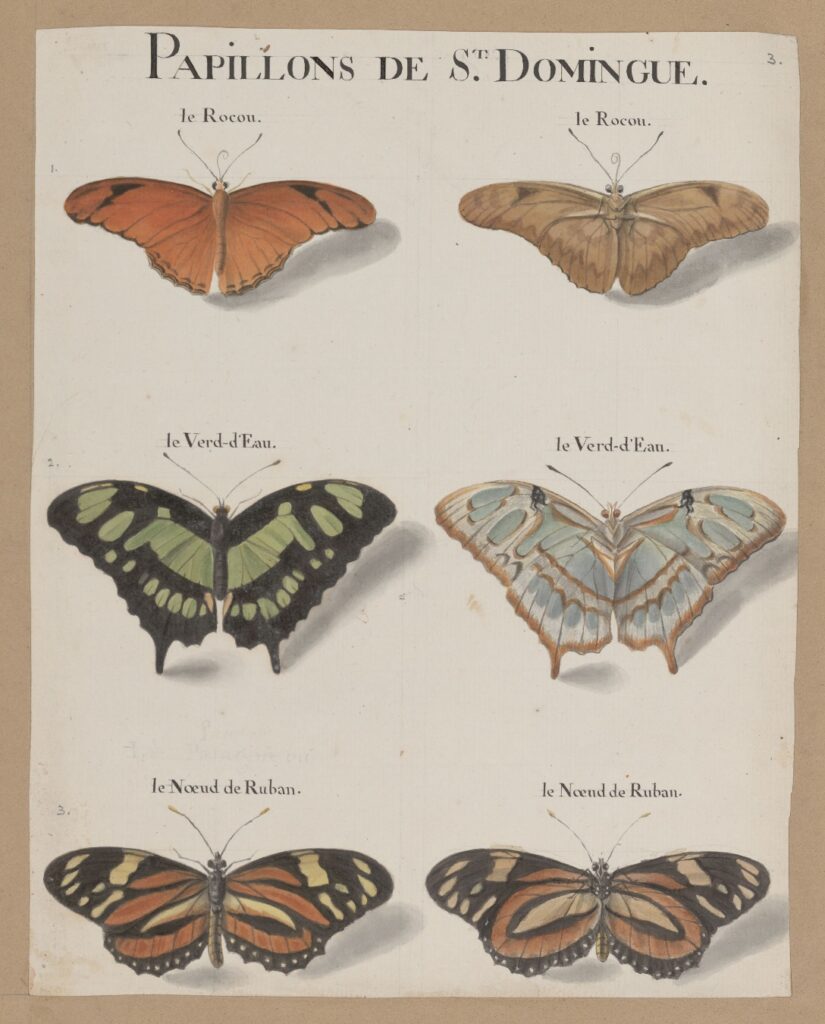
On 19 February 1766, a French engineer who had lived almost half his life in the French colony of Saint Domingue (now Haiti) sat down to paint a moth. This would not have been a remarkable event, if it had not heralded the beginning of a project of natural history that was to occupy René Gabriel de Rabié (1717-85) for the rest of his life. Over the next two decades, de Rabié painted over 300 watercolors of the flora and fauna of Saint Domingue. Now bound in four albums, the watercolors were acquired in 1930 by Casey Wood for the Blacker Wood Natural History Collection at McGill Libraries in Montreal.
The life of René Gabriel de Rabié is a minor footnote to the larger story of the French colonial enterprise in Saint Domingue, which transformed the natural and cultural environment in remarkable and appalling ways, creating a plantation economy and a slave society.[1] Of all the colonies in the French Caribbean, Saint Domingue had the highest ratio of enslaved peoples to French colonists and free people of color. The town of Cap François, with its stone architecture, public squares, gardens and fountains, some designed by de Rabié, was described as the “Paris of the Antilles,” which belied the composition of its population. Of the 15,000 inhabitants in 1790, fully two-thirds were enslaved peoples; the remaining one-third were European colonists (24%) and free people of color (10%).[2]
Around 1747, de Rabié married Anne Lebon or Le Bon, a name associated with a large Créole family in Saint-Domingue. (In the context of Saint Domingue in the eighteenth century, the term “Créole” referred to a person born in the colony, and could comprise residents of European, African, or mixed descent.[3]) De Rabié and his family lived in a slave society. He owned numerous enslaved people who managed the house and gardens in Cap François or farmed the provisioning grounds close to the establishment of Les Pères de la Charité outside the town. There is a telling entry in the estate inventory made after de Rabié’s death in 1785: “Item, a notebook that appeared to have served the said S[ieur] Rabié as a journal in which he recorded family affairs, the births of the Blacks in his household, the proceeds and expenses….”[4] It is difficult to document the lives and activities of these unnamed workers, but we can catch glimpses of de Rabié’s extended household through brief notices in newspapers and public records.
Notices in the Saint-Domingue periodical Les Affiches Américaines reveal that De Rabié was an active participant in the buying, selling, and trading of enslaved workers. In 1774 he acted as agent for the sale of five enslaved people belonging to Jean François Vincent de Montarcher (1730-83), a former Intendant of Saint Domingue. These individuals included two coachmen, Charlot and Cesar; Louis, a maître d’hôtel and confectioner (confiseur); Laviolette, a servant and wigmaker; and Perrine, a laundress. They were available for a trial period, to be sold separately or together.[5] This notice highlights the diversity of skills that enslaved people acquired. Either recently arrived or second- and third-generation (Créole) enslaved people drove coaches, made preserves and sweets, styled wigs, and laundered and pressed clothes. Other advertisements in Affiches describe enslaved people as sailors, fishers and divers, cooks and domestics, seamstresses and tailors, saddlers and coopers, bakers, smiths, and carpenters. When de Rabié’s son and daughter-in-law left for France in spring of 1786, they advertised for sale not only their maid, who was a cook and a laundress, with her child, but also a forge, complete with four enslaved smiths.[6]
Did De Rabié’s enslaved workers assist him with the gathering of specimens or with the production of his natural history illustrations? While there is no direct evidence in the notes on his drawings, nor in any existing correspondence, it is very unlikely that de Rabié would have been able to acquire specimens or paint and name the plants and animals without the skills and knowledge of many hands, from family members to enslaved servants. When birds were procured by enslaved hunters, the skins were likely prepared by a cook or other enslaved kitchen workers. The fish caught by crews of enslaved fishers were brought back from the market by enslaved servants. The caterpillars plucked off leaves were supplied with fresh food by the gardeners, who may also have captured the butterflies on the wing.[7] Fetching and grinding pigments from the apothecaries, sharpening quills, cleaning brushes, and mixing colors were also tasks often done by enslaved domestic workers. It was not, however, only physical labor that these unnamed assistants supplied. In some cases, they also provided knowledge that de Rabié lacked.
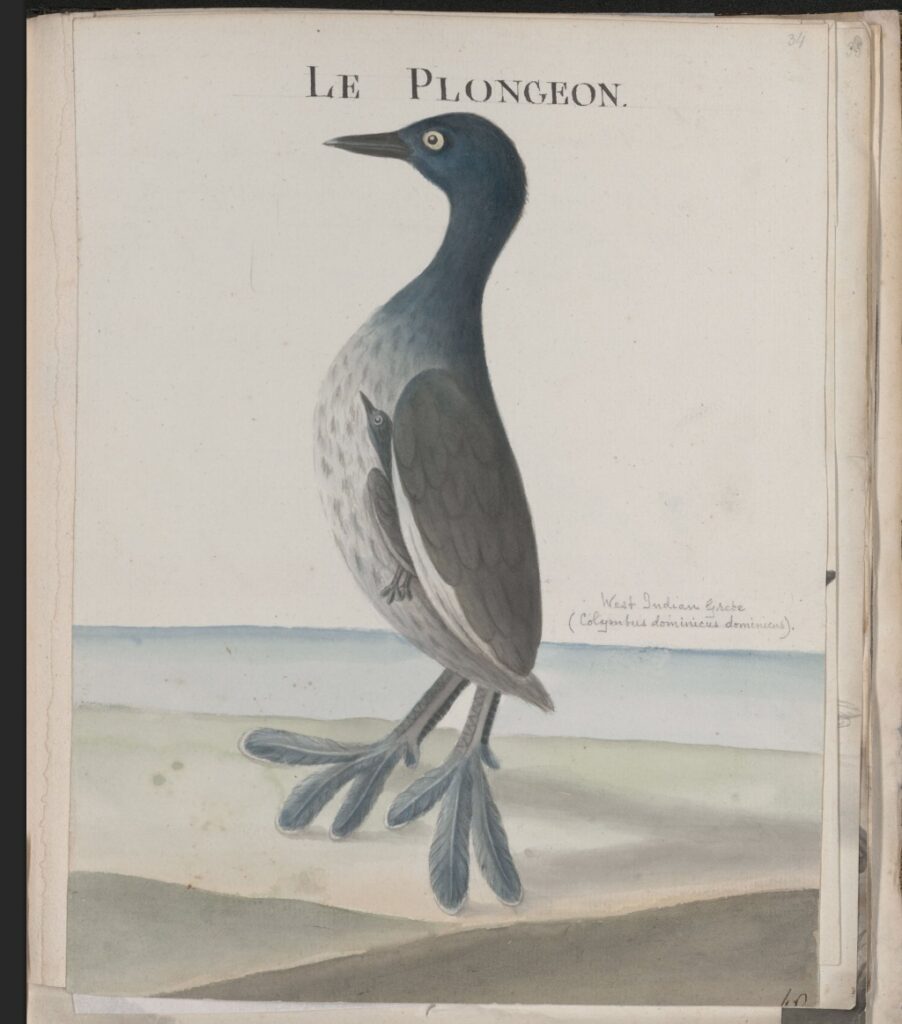
On 3 September 1778 de Rabié painted “Le Plongeon” or “The Diver.” Like many eighteenth-century collectors, de Rabié relied on local hunters to procure birds. This bird’s awkward posture suggests he painted from a skin, but he included an unusual detail: a tiny chick tucked under the wing of the adult. On the back of the watercolor he wrote: “The female diver, this bird has a great love for her young … She hides them under her wings, diving with her young, she does not abandon them even up to her last day….”[8] The Plongeon is the Least or Antillean Grebe (Tachybaptus dominicus), called in Haitian Creole “Ti Plonjon,” still resident in the Caribbean but uncommon today in Haiti. The birds build floating nests in freshwater ponds and are notoriously shy, diving swiftly at the first sign of an intruder. Both male and female protect their young by concealing them in their feathers and even diving with them under water. This behavior was not recorded by another European naturalist until Prince Maximilien von Weid described it in Beiträge zur Naturgeschichte von Brasilien (Weimar, 1825-33). It is very unlikely that de Rabié would have seen the behavior of such an elusive bird; a hunter, however, would have had ample time to watch the bird and to capture not only the adult but also the chick. The note is unattributed, but it is easy to imagine the story told to the French engineer by an enslaved hunter who brought the bird to Cap François.
[1] There is a large literature on Saint Domingue, particularly focused on the revolution in the 1790s. There are fewer works that examine the environment and social history of Saint Domingue before that period. These include P. Morgan et al, Sea and Land: An Environmental History of the Caribbean (2022); J. McClellan and V. Saint-Louis, Colonialism and Science: Saint Domingue in the Old Regime (1992); J. McClellan and F. Regourd, The Colonial Machine: French Science and Overseas Expansion in the Old Regime (2011); R. Anderson et al (eds.) Islands, Forests and Gardens in the Caribbean: Conservation and Conflict in Environmental History (2006). Authors writing about slave society in Saint Domingue include among others G. Debien, Les Esclaves Aux Antilles Françaises, XVIIe-XVIIIe Siècles (1974), and J. Garrigus, A Secret among the Blacks: Slave Resistance before the Haitian Revolution (2023). Londa Schiebinger has published extensively on colonial botany, and more recently on Secret Cures of Slaves: People, Plants, and Medicine in the Eighteenth-Century Atlantic World (2020). Science in the French Atlantic was included in J. Delbourgo and N. Dew, Science and Empire in the Atlantic World (2008).
[2] P. Morgan et al, Sea and Land: An Environmental History of the Caribbean (2022), Table 1.3
[3] ‘The term itself derives from the Spanish criollo and Portuguese crioulo, meaning someone or something usually of foreign derivation that becomes native to a new locality. Creolization thus refers to processes of exchange and adaptation …’. P. Morgan, op. cit., n.p. (online edn.).
[4] “Item un cahier qui parait avoir servi aud. S. Rabié de journal surquel il inscrivait ses affaires de famille, les naissances des nêgres de son habitation, le produit d’icelle et ses depenses…” Rabié Inventaire. The notebook has not been located. For another example of a similar notebook, see François Amable Dubreuil de Foureaux, Liste d’esclaves, 1775-1780, Bibliothèque Mazarine, Fonds Marcel Châtillon, Papiers concernant François Amable Dubreuil de Fonreaux [sic], Ant Ms 16-9; https://bibnum.institutdefrance.fr/ark:/61562/mz2737 (accessed 7 April 2023).
[5] “Quatre Nègres & une Négresse, appartenans à M. de Montarcher, ancien Intendant de Saint-Domingue, nommés Charlot, cocher; Cesar, Indien, aussi cocher; Louis, maître d’hôtel & confiseur; Laviolette, domestique & perruquier; & Perrine, blanchisseuse: on les donnera à l’essai, & on les vendra ensemble ou séparément, à la meilleure composition possible. Il faut s’adresser à M. Rabie, Ingénieur en Chef au Cap, ou à M. Rocher, fondé de pro-curation M. de Montarcher.” Affiches Américaines, 18 June 1774, p. 310. A note on “Indien”: Cesar was likely a “panis” or Amerindian slave, traded into Saint Domingue from Québec. See discussion in B. Rushforth, Bonds of Alliance: Indigenous and Atlantic Slaveries in New France (Chapel Hill, 2013), pp. 165–73, pp. 299–367.
[6] “M. & Madame Rabié partent pour France du 10 au 15 du mois prochain … il vendra son fonds de boutique, consistant en deux forges bien montees, quatre Negres forgerons, bons ouvriers, & une Négresse nourrice, avec son enfant, cuisiniere, bonne blanchisseuse & repasseuse …” Affiches Américaines, 12 April 1796, p. 192.
[7] See the example of Maria Sibylla Merian, who directed her Black enslaved servant to bring her caterpillars and other insects that he found in the woods. Maria Sibylla Merian, Metamorphosis insectorum Surinamensium, Den Haage (1726), p. 66. BHL: https://www.biodiversitylibrary.org/bibliography/200100 (accessed 20 October 2025).
[8] “le plongeon femelle, cet oiseau a un grand amour pour ses petites, [writing trimmed] Elle les cache sous les ailes, en plonger avec ses petits, elle ne les abandon pas mesme dernyer de celle …,” inscription on verso, “Le Plongeon” in Original water-colour paintings on the natural history of St. Domingo, vol. 1, p. 35.
Cite this post as: Victoria Dickenson, “René de Rabié, the Hunter, and the Ti Plonjon,” Colonial Networks (December 2025), https://www.colonialnetworks.org/?p=921.
Meredith Martin (NYU) and Hannah Williams (Queen Mary University of London)
Throughout 2025, we have had the honor and pleasure of working with the Haitian-born international digital and video artist, Maksaens Denis. Maksaens generously agreed to work with us to produce an animation and digital collage which will feature as the introduction and framing design for our Critical Counter Map. From the beginning, Maksaens was deeply engaged in the historical context surrounding the counter map and intuited what we are seeking to do through this remapping project. We learned so much from him and are grateful that he contributed his time, energy, and creativity to the project. We would also like to thank Florence Alexis and Pascale Monnin, who introduced us to Maksaens and his work.
Maksaens’s contemporary art practice is deeply engaged with Haitian history and its multilayered complexity. He agreed to answer some of our questions about his creative process and broader interests. We have published the interview here with the questions we posed in English, the answers Maksaens gave in French, and our English translation of those responses. We have also included an artist biography and some examples from Maksaens’ historically embedded and visually arresting œuvre.
Maksaens Denis is a visual artist, born and raised in Haiti, who currently lives between Haiti and the Dominican Republic. He is recognized for his activism through his artwork, creating works that speak of the dramatic economic and political situation experienced by the population in Haiti. His work deals with topics related to spirituality, Vodou, and the questions that surround it, and he is also interested in exploring homosexuality and same-sex love as well as the injustice and discrimination experienced by the LGBTQI community in Haiti. Denis’s work spans several disciplines, from installation to video art, photography, printmaking, and sculpture, and since the 90s, he has also acquired significant experience in Techno VJ-ing.
Denis is an established international artist who has exhibited worldwide in Europe, America, Africa, and Asia. He is the recipient of multiple international grants, awards, and fellowships, and is renowned as a pioneer in multi-media and digital art using mapping techniques in the Caribbean. Denis loves to play with the duality and contrast of images, and effortlessly combines a visual aesthetic inspired by electronic music, Vodou culture, and other sources. He collaborates with artists from diverse disciplines, including visual artists, filmmakers, photographers, poets, dancers, and performers, in residencies held in various countries worldwide.
1. What can you tell us about the role that Haiti’s past plays in your work?
Avant de répondre directement à cette question il faudrait que j’explique ma surprise durant les premières années quand je suis arrivé en France, dans les années 90, de voir la méconnaissance totale de l’histoire d’Haïti (jadis colonie française de Saint Domingue) et de cette partie de leur propre histoire. Cette méconnaissance, voire cette ignorance d’une grande partie de la population française m’a tout de suite fait sentir qu’il y avait une volonté de cacher la vérité et, par racisme, de minimiser la révolution haïtienne, la victoire des Haïtiens et la 1ère grande défaite de Napoléon.
Ce constat m’a porté à réaliser en 2004 le documentaire “l’Arbre de la Liberté” expliquant l’histoire d’Ayiti du 14e au 19e siècle puis j’ai trouvé intéressant d’intégrer des images visuelles issues de mon documentaire dans mes performances video Live (Vj).
Before answering this question directly, I should explain how surprised I was during my first few years in France, in the 1990s, to see how little French people knew about the history of Haiti (formerly the French colony of Saint Domingue) and about this part of their own history. This lack of knowledge, or even ignorance, for a large part of the French population immediately made me feel there was a desire to hide the truth and, out of racism, to minimize the Haitian revolution, the victory of the Haitian people, and the first major defeat of Napoleon.
These observations led me to make the documentary “The Tree of Liberty” in 2004, explaining the history of Haiti from the 14th to the 19th century. I then found it interesting to incorporate visual images from my documentary into my live video performances (VJ).
2. How does your multilayered, multidisciplinary work as a digital and video artist lend itself to explorations of Haiti’s complex, interwoven histories?
Nous avons une histoire unique, magnifique, mal connue et aussi comme vous dîtes, des histoires complexes et entremêlées. Pour moi c’est important de montrer à chaque fois des bribes de notre histoire et le traitement multicouches que j’utilise souvent, est d’après moi très approprié pour montrer la complexité de nos histoires. Aussi, que ce soit dans mes performances ou dans mes créations plus plastiques j’aime bien qu’il y ait plusieurs niveaux de lecture. En ce sens, le contemporain peut parfois renvoyer au passé et vice-versa dans mes créations.
We have a unique, magnificent, little-known history and, as you say, histories that are complex and intertwined. For me, it is important to show snippets of our history each time, and the multi-layered treatment I often use is, in my opinion, very appropriate for showing the complexity of our stories. Also, whether in my performances or in my more visual work, I like there to be several levels of interpretation. In this sense, the contemporary can sometimes refer to the past and vice versa in my creations.
3. Have there been any specific encounters with historical or archival materials – artworks, documents, maps – that have shaped your artistic approaches or shifted your creative directions?
En 2003 quand j’effectuais mes recherches pour mon documentaire, j’ai trouvé très peu d’images d’archives. Ce sont souvent les même que je rencontrais dans les livres ou sur internet. Je me suis servi de quelques-unes mais pour pallier ce manque, je me suis tourné vers les œuvres de peintres haïtiens modernes et contemporains, principalement de la seconde moitié du XXe siècle, parmi lesquels Frantz Zéphirin, Serge Moléon Blaise, Jean Saint-Fleur et Jean-Baptiste Théard. A l’occasion d’une exposition de peintures haïtiennes à Pontarlier, France organisée par la Galerie Monnin en 2003 j’ai pu obtenir l’autorisation de filmer les peintures haïtiennes qui s’y trouvaient, racontant d’une manière très particulière l’histoire d’Haïti. Ces peintures se retrouvent dans mon documentaire mais ont aussi souvent été utilisées dans mes projections live avec musique électronique.
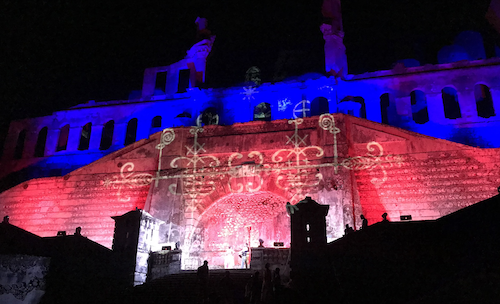
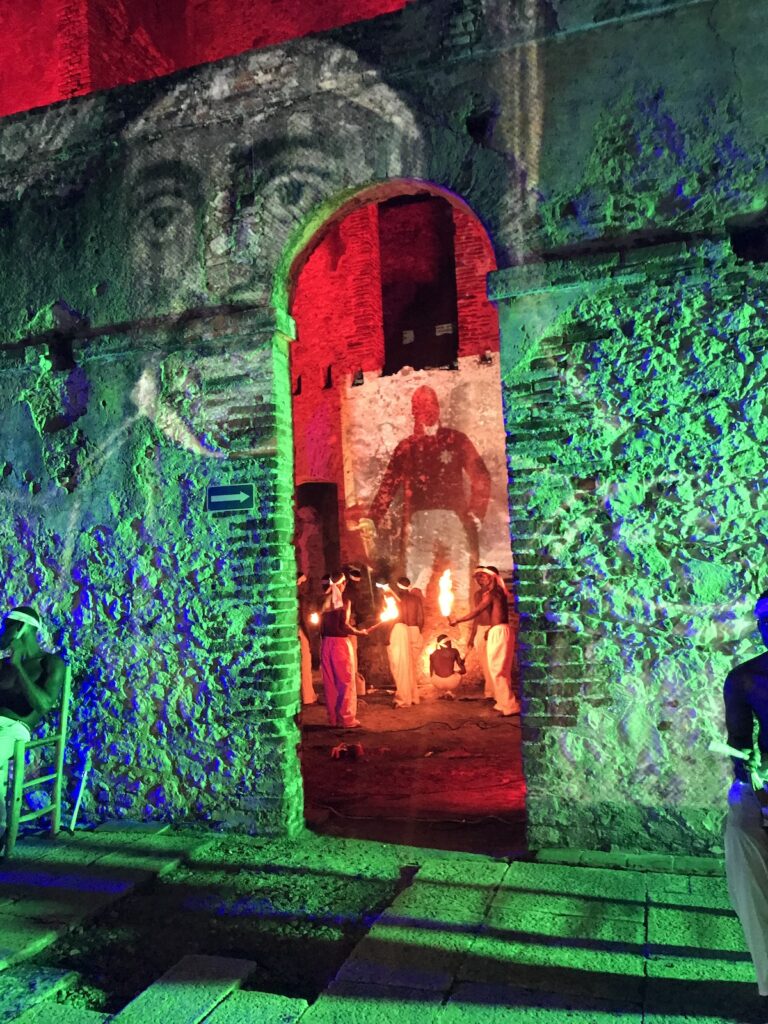
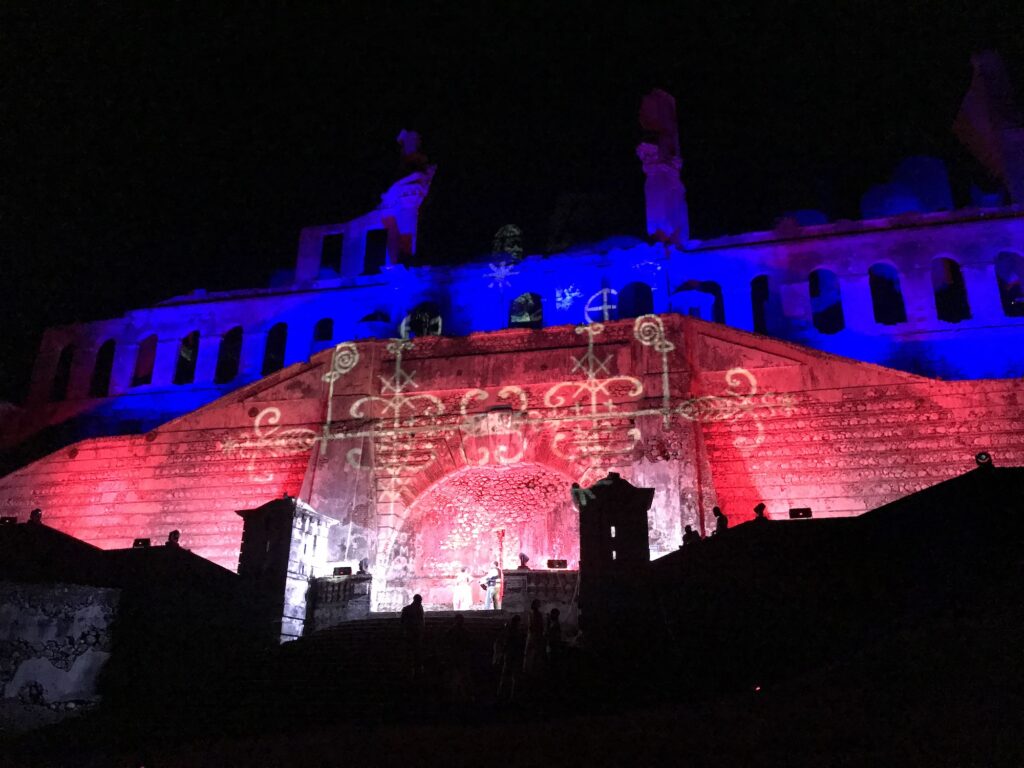
En 2020, la Fondation Haïti Jazz et l’UNESCO m’ont confié la réalisation d’un mapping sur les murs du palais Sans-Souci, qui a été accompagné d’une performance de Linda François et d’autres danseurs, avec une mise en lumière signée Pro-Fête. Pour créer la vidéo du mapping, j’ai pu utiliser des images de la bibliothèque d’archives en libre accès en ligne et libre de droits de la New York Public Library (NYPL Digital Collections). J’y ai trouvé des images d’archives d’Haïti que je n’avais vu nulle part ailleurs : dessins, gravures, peintures de nos héros de l’indépendance, photo des pièces gravées par le roi Christophe, à l’effigie de Makandal, etc… Puis pour ce travail pour la Contre carte, j’ai pu avoir accès aussi à d’autres images très intéressantes.
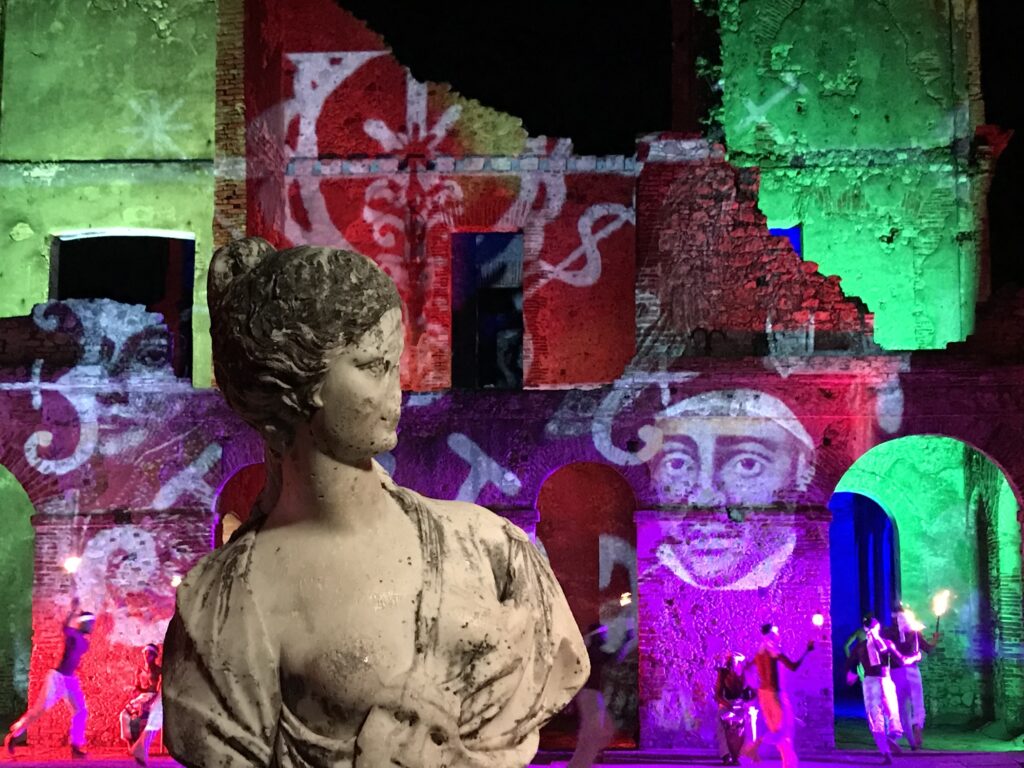
In 2003, when I was conducting research for my documentary, I found very few archival images. They were often the same ones I had come across in books or on the internet. I used a few of them, but to make up for the lack of material, I turned to works by modern and contemporary Haitian painters, mostly from the second half of the 20th century, among them Frantz Zéphirin, Serge Moléon Blaise, Jean Saint-Fleur, and Jean-Baptiste Théard. During an exhibition of Haitian paintings in Pontarlier, France organized by the Galerie Monin in 2003, I was able to obtain permission to film the Haitian paintings on display, which tell the story of Haiti in a very unique way. These paintings are featured in my documentary but have also often been used in my live projections with electronic music.
In 2020, the Haiti Jazz Foundation and UNESCO entrusted me with creating a mapping projection on the walls of the Sans-Souci Palace, accompanied by a performance by Linda François and other dancers, with lighting design by Pro-Fête. To create the mapping video, I was able to use images from the New York Public Library (NYPL Digital Collections), an online archive that is freely accessible and royalty-free. I found archival images of Haiti that I had never seen anywhere else: drawings, engravings, paintings of our independence heroes, photos of coins engraved by King Christophe, bearing the image of Makandal, etc. Then, for this work for the Counter Map, I was also able to access other very interesting images.
4. We’ve been so honored to engage collaboratively with you on our Critical Counter Map. What was your experience like developing this work? Either in terms of your reaction to the visual sources or to the historical themes you encountered with the project?
Cette proposition de travailler sur la “contre-carte historique” et la manière de montrer l’histoire de mon pays m’a tout de suite interpellé. J’ai senti encore une fois ce besoin, et cette fois cela ne venait pas de moi, de rétablir la vérité en faisant parler les images. Tout de suite après avoir été approché par Meredith Martin et Hannah Williams pour réaliser ce travail j’ai pu avoir accès à des documents d’archives très importants et bien documentés. J’ai été impressionné, surpris, honoré moi aussi, et tout de suite intéressé à travailler sur le projet. J’ai aussi pu avoir l’autorisation d’utiliser la création d’un autre artiste contemporain que j’admire, Raphael Barontini, dans l’œuvre ce qui m’a aussi honoré.
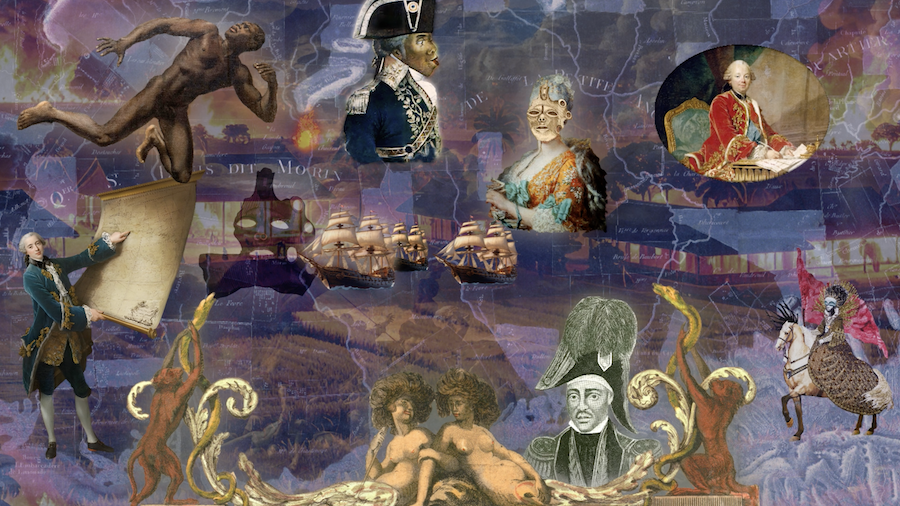
Dans l’ensemble j’ai senti que c’était un grand défi par rapport à l’importance du sujet. Mais ce qui m’a le plus plu, c’est le fait de résumer 3 siècles d’histoire d’Haïti en 12 secondes d’animation. Morceaux choisis, bien sûr. Tout n’y est pas.
This invitation to work on the Critical Counter-Map and to find a way to show the history of my country immediately appealed to me. Once again, I felt the need—and this time it didn’t come from me—to restore the truth by letting the images speak for themselves. Immediately after being approached by Meredith Martin and Hannah Williams to do this work, I was given access to very important and well-documented archival materials. I was impressed, surprised, honored, and immediately interested in working on the project. I was also given permission to use the work of another contemporary artist I admire, Raphael Barontini, in the project, which was also an honor.
Overall, I felt that it was a great challenge given the importance of the subject. But what I liked most was the fact that I was able to summarize three centuries of Haitian history in 12 seconds of animation. Selected pieces, of course. Not everything is there.
5. What responses do you hope to evoke in contemporary viewers encountering your work – especially regarding perceptions of Haiti’s past?
J’espère que ce travail va provoquer des interrogations, susciter la curiosité et va pousser les viewers à entrer dans les pages du site pour voir et comprendre l’histoire d’Haïti, une partie importante des histoires du capitalisme et du colonialisme et avoir une autre (meilleure) compréhension du passé.
I hope that this work will provoke questions, spark curiosity, and encourage viewers to visit the website to see and understand Haiti’s history, an important part of the histories of capitalism and colonialism, and to gain a different (better) understanding of the past.
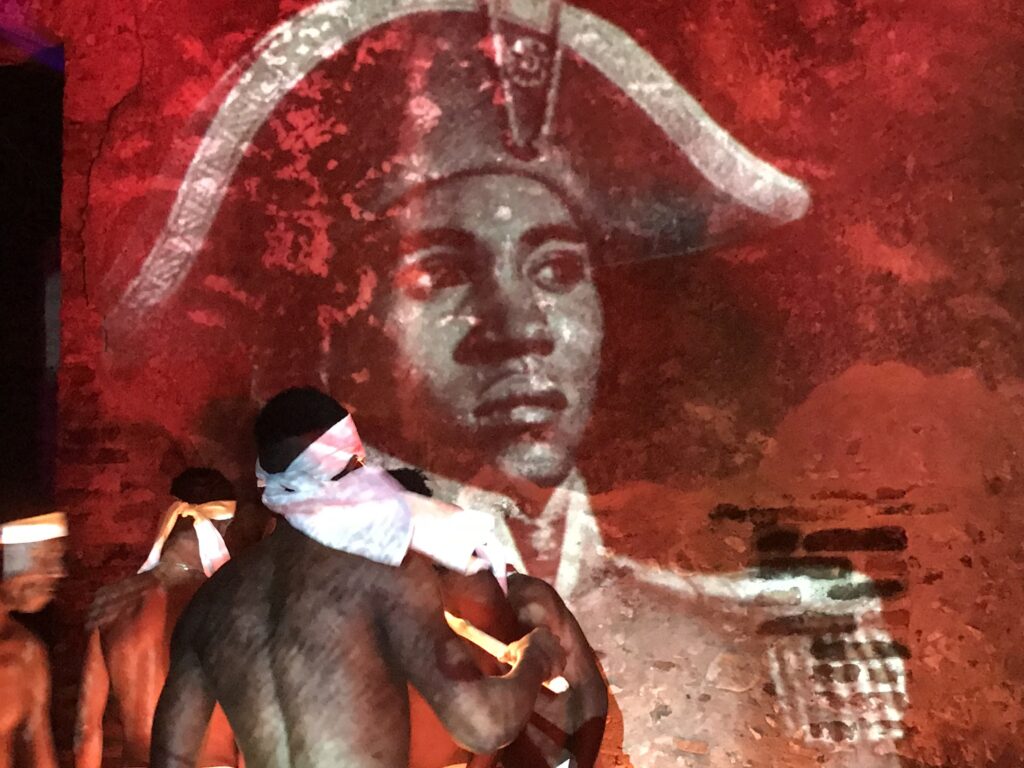
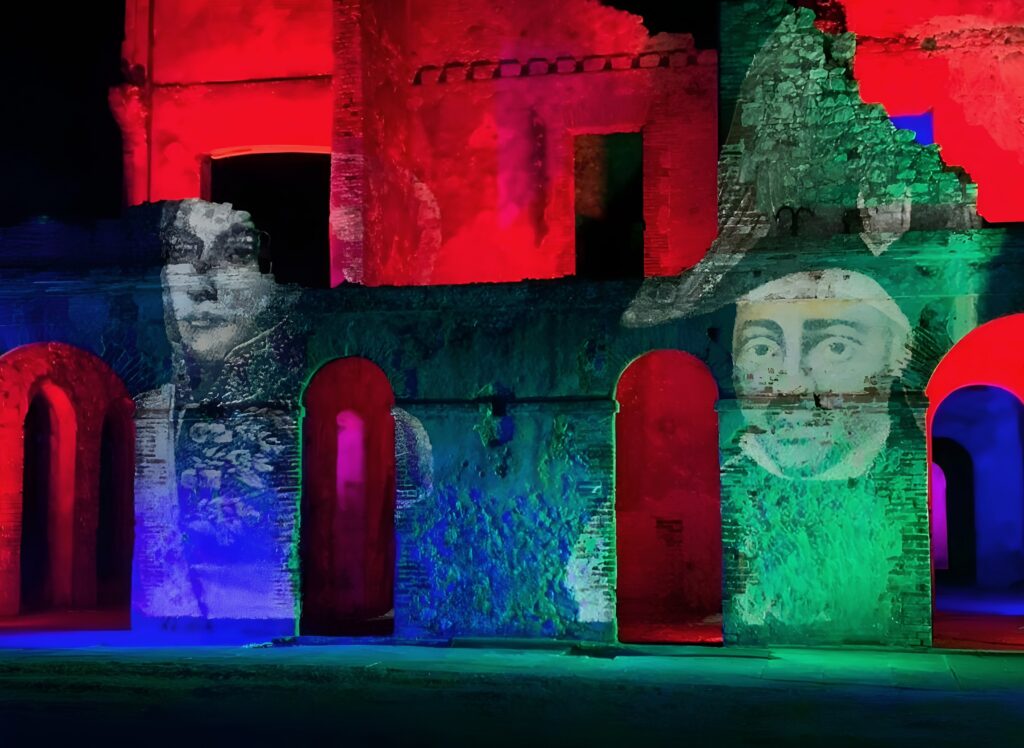
Cite this post as: Meredith Martin and Hannah Williams, “Counter-Mapping Haitian History: An Artist’s Interview with Maksaens Denis,” Colonial Networks (September 2025), https://www.colonialnetworks.org/?p=899.

Arielle Xena Alterwaite (Brown University)
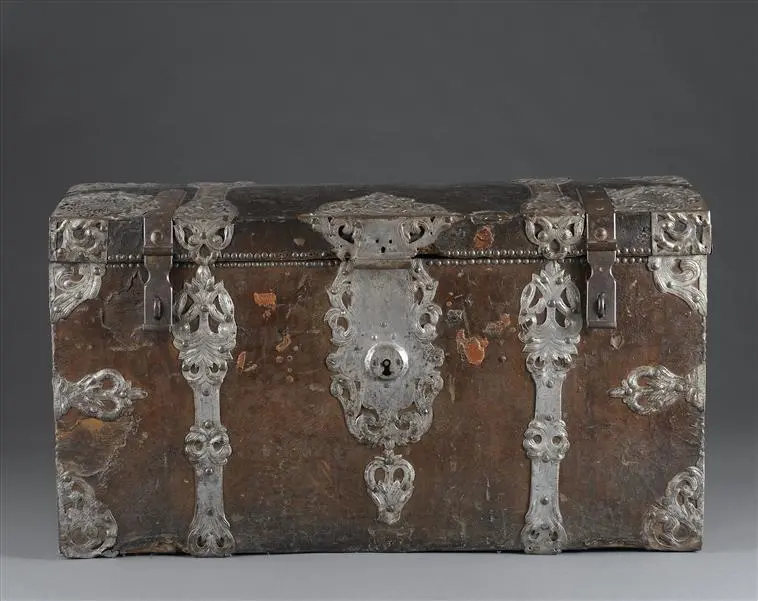
On June 26, 1826, the French merchant vessel L’Hébé left Port-au-Prince, Haiti. Captained by Mr. Forsans, it contained the purported monetary value of one million Haitian gourdes in coins, carried in 20 chests, each filled with five numbered boxes, totaling 100 boxes.[1] One of these chests (Fig. 1) survives in the museum of the Château de Compiège; it was donated by the Caisse des Dépôts et Consignations, the French state financial institution charged with the arbitration of Haiti’s sovereign debt. Each of the chest’s boxes was meant to contain 625 “quadruples d’espagne” in Spanish gold, which would form a total estimated sum of 62,500 “quadruples.” This was the amount required to pay the first installment of Haitian debt owed to the French state following the passage of what has since become known as the 1825 Haitian Indemnity.
In 1791, the enslaved and free people of color in the French plantation colony of Saint Domingue rebelled. After the spectacular defeat of French, British, and Spanish troops over the next decade, in 1804, the revolutionaries secured independence, renamed their polity Haiti, and abolished slavery within its borders. Finally, after two decades of diplomatic negotiations and several regime changes within Haiti and France, respectively, Haitian President Jean-Pierre Boyer and French King Charles X reached an agreement that resulted in the passage of two separate laws, one in France and the other in Haiti.
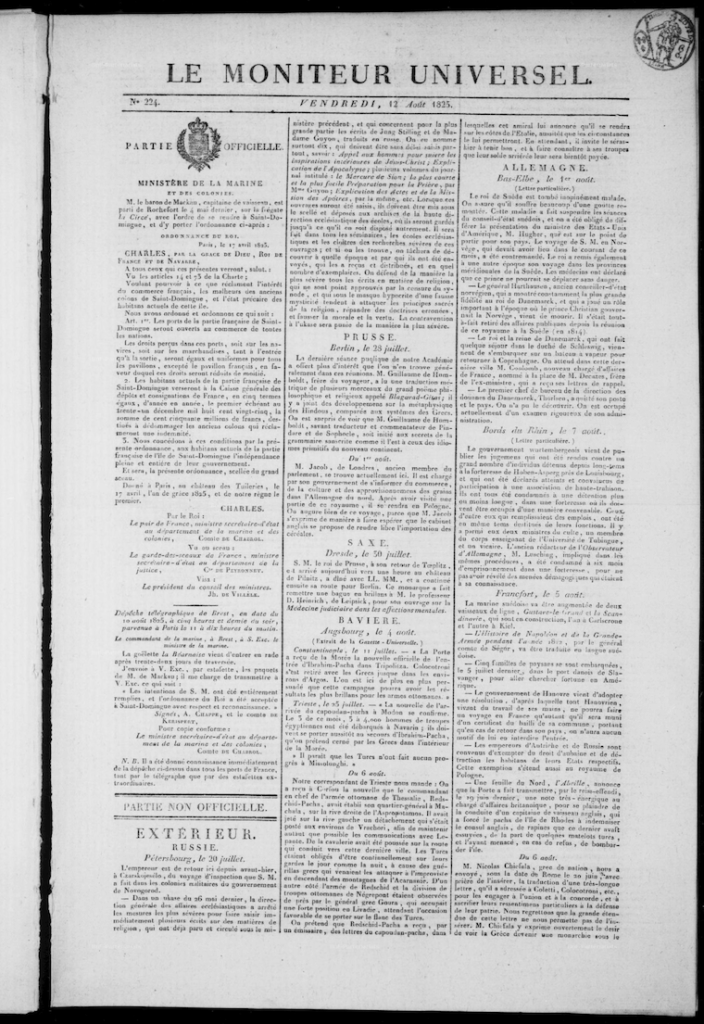
On the French side, France would gain favorable trading privileges with Haiti, and Haiti would owe former French plantation owners 150 million francs in indemnities due in annual installments (Fig. 2). In exchange, France would recognize the eastern part of the island—the territory that had formerly fallen under French colonial rule—as a sovereign nation, but not the entire island, despite its recent consolidation under Haitian rule.
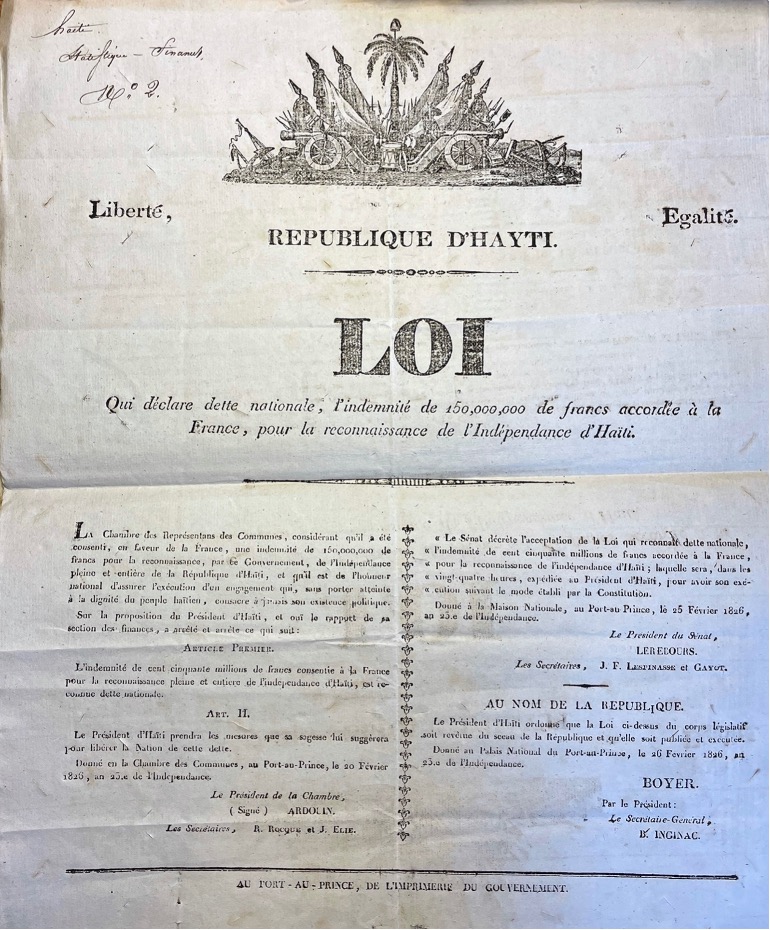
By contrast, in Haiti, the law that established the 1825 Haitian Indemnity looked very different (Fig. 3). It recognized the 150 million francs indemnity as a national debt owed to France, and it passed the Haitian senate without mention of the planters or Haiti’s responsibility to them. It was instead established as a debt between two sovereign entities. Furthermore, no mention was made in Haiti about either the trade deal or the territorial limitations on sovereign recognition established by France—a significant omission, considering that in 1822 Boyer had successfully unified the entire island, including today’s Dominican Republic, under the jurisdiction of the Haitian state.
In addition to the encoded discrepancies between the French and Haitian laws, there were more complications that impacted the payment or nonpayment of Haiti’s debt. For one, the departure of L’Hébé from Port-au-Prince’s harbor did not go as smoothly as French foreign agents anticipated, and Mr. Forsans reported an altercation among Haitians and Frenchmen as the chests were loaded onto the ship. Perhaps the encounter was similar to another Mr. Forsans experienced several months later when he returned to Haiti to engage in commercial transaction. Then, when L’Hébé’s departure passed below Fort Bizoton to the east of Port-au-Prince, Mr. Forsans reported that seven or eight men approached the ship in a “red boat with lavender sails.” Following an hour-long exchange of “the most insulting words,” Haitian sailors, racially identified by Mr. Forsans as both “colored” and “black,” allowed L’Hébé to depart with the coin-stuffed chests that had been filled at the Haitian treasury.[2] And although their names and voices remain absent from the fraught historical record, we nonetheless have a glimpse at the real threat that their actions posed to shipment of money and goods in the name of indemnity payments.
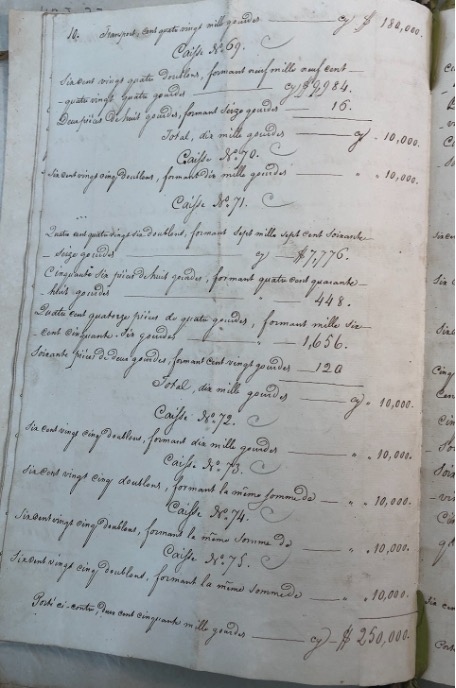
There were still further material realities that threatened to undermine the French extraction of specie payments from Haiti in practice. Although chests like the one pictured above were supposed to contain a set sum in the currency of the franc (France’s national currency, which was pegged to gold and silver), the Haitian government had valued the sum in its own national currency, the gourde. At the same time, despite France’s efforts to establish the franc as an international standard during an era of many global currencies, Haitian authorities often filled the payment chests with a variety of coins, not solely French francs. For example, in the first installment shipment, 34,551 gourdes of the total million were paid out specifically in Haitian-minted coins, rather than French specie. French officials, tasked with verifying and sorting these mixed payments, kept meticulous records of the different coins received—an act documented in their official tallies (Fig. 4). In so doing, these officials bolstered France’s efforts to standardize payments solely in the monies of the lender. In today’s terms, this is precisely what economists Barry Eichengreen and Ricardo Hausmann refer to as the problem of “original sin,” in which a sovereign nation is unable to borrow abroad in its own national currency, resulting in an external debt denominated in foreign currency that exposes the developing nation to exchange rate risk and financial fragility.[3] We might, therefore, argue that the monetary form Haiti’s sovereign debt took constituted an early experiment in a practice that would pervasively expand to impoverish nations in the Global South.
Yet Haiti’s metallic messiness was not merely arbitrary. It signaled Haitian actors’ attempt to exercise some agency over how the debt would be paid and to resist French demands. French officials, meanwhile, readily attempted to sabotage the Haitian state’s monetary sovereignty by undervaluing Haitian specie shipments. For example, although this first payment of the indemnity was meant to be equivalent to six million francs, upon arrival in France, the specie was valued by French officials at a mere 5,300,000 francs. The French state further discredited Haitian coins, noting they lacked sufficient metal content to be of equivalent value to other European currencies.
On the surface, the problem of Haitian coins was repositioned as an issue of international monetary standards, but at the same time, it served as a means through which France could impose structural barriers to Haitian autonomy. When Haitian President Jean-Pierre Boyer came to power in 1818, he issued a new coinage featuring his effigy, based on a weighted system (with each gourde weighing “50 grains,” the half-piece escalin “25 grains,” and the quarter trois sous “12 ½ grains”). Yet according to a French consular report from October 30, 1826, French officials claimed that the Haitian government had gathered “all the materials of money which one could find, & in particular all the Spanish species which existed in the various coffers of the State and put them in the furnace with unspecified proportions of other metals.” Copper, brass, tin, zinc, and lead were all used as alloys, resulting in coins that, again according to the French, contained only a quarter and sometimes as little as a fifth of gold or silver. Furthermore, the French consuls claimed, “various materials were thrown into molds” without being weighed separately, resulting in different metal values for coins minted “from one day to the next”[4] (Fig. 5).
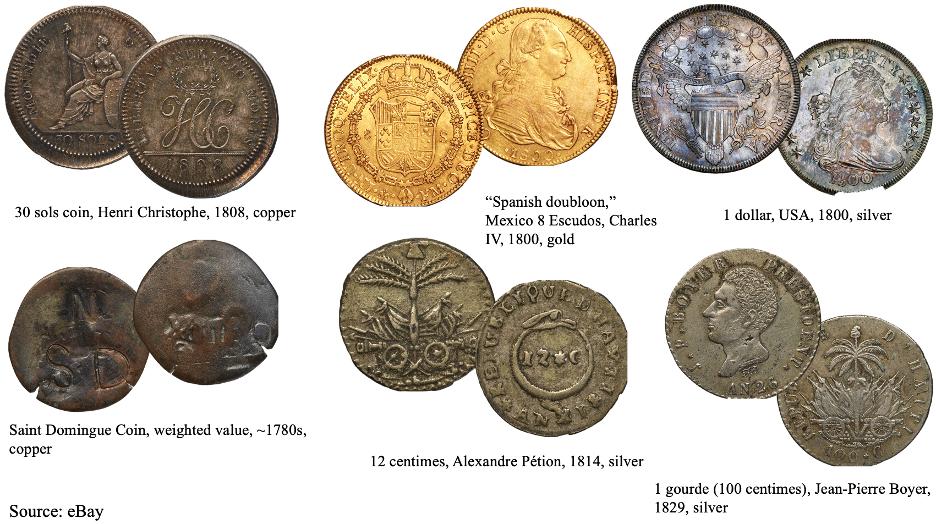
Over and above French officials’ squabbles, the symbolism of the coins minted in Port-au-Prince both synthesized and challenged Western monetary ideas, showing material faces that represent the crux of modern financial imperialism. For example, in 1813, Haitian President Alexandre Pétion issued the minting of new silver coins in denominations of 6, 12, and 25 centimes. They bore the Haitian palm tree of liberty topped with a French revolutionary Phrygian cap on one side, and a serpent biting its tail on the other. Historian Johnhenry Gonzalez has argued that the snake represented the Dahomey and Vodou deity Damballah Wedo, or the creator. In his words, these “unique coins are the first and only New World currency to feature the image of an African deity.” [5]
The very existence of these coins symbolized a profound transformation: in a society where slavery had once forbidden the enslaved from handling money, the ability to mint and circulate national currency now marked the political change brought by emancipation, making it possible for formerly enslaved people to participate in commercial life as economic actors. Although it is difficult to definitely say whether the symbolism was, in fact, perceived by many Haitians as such, in the wording of the official law, the serpent consuming its own tail was meant to be interpreted as an “emblem of prudence,” avoiding any official mention of anything that might approximate vodou epistemology.[6] Still, by 1828, Boyer ordered the snake coins to be removed from circulation, replacing their effigy with his own, effectively effacing the potentially spiritually potent token with a classically Western motif.[7] While the placement of Boyer’s profile now parroted the design of European coins like the franc (which displayed the portrait of Charles X on one side, and the House of Bourbon’s coat of arms on the other), Haitian resilience nonetheless persisted in the national insignia—threatening canon fire—and in the very fact of their domestic minting and global circulation.
Even if fixing the metal content of Haitian gourdes were possible, and even if specific expressions of Haitian symbolism were removed from its coinage, foreign powers continually cast Haiti as a place plagued by counterfeit coins. There were “immense quantities of false gourdes being made in the United States, mainly in New York,” one report claimed, “where they are sold publicly and in various price ranges.” False coins were supposedly also minted in Glasgow, Scotland, and, in both cases, “the introducers take care to make an assortment of the various false types, to which they mix good ones, a necessary precaution to deceive more surely the farmer, who, in spite of his ignorance, would be suspicious at the appearance of a certain number of entirely similar pieces.” As a result, false money circulated less among merchants in commercial ports, but was traded directly with Haitian coffee producers in “the houses of the interior.”[8]

Although French officials devalued Haiti’s material payments, this did not stop the sale and liquidation of what Haiti did ship within the French state. In subsequent years, the Haitian state sent still more assorted metals and even commodities like coffee to make payments on the indemnity. Just a few months after the initial specie-only shipment brought to France on L’Hébé, the Haitian government used its own recently purchased ship L’Haïtien, loaded with “old copper,” coffee, cotton, and dyewood, for the second payment bound for Le Havre, only to be denied by the French government as a full means of payment.[9] But in the event that the Haitian government did send chests of coins, when these monies arrived in Paris, they would be offered up for sale at a public auction by posters (see Fig. 6 for a surviving example, albeit from the 1840s) so that they could be sold to private bankers in exchange for French francs.
Only once the conversion took place could francs purchased on behalf of the Haitian government be deposited in the Caisse des dépôts et consignations. The francs would be held by the Caisse until, in every case, a former French plantation owner and his or her descendants were deemed eligible by a French government commission to apply for an indemnity payment. They would only receive the portions of the total amount in annual instalments, subject to when Haitian chests filled with coins again arrived in France. Ultimately, the form of Haiti’s debt payments mattered greatly in the first half of the nineteenth century. The materials of money—the actual coins, metals, and even goods sent from Haiti to France—played a crucial role in shaping both the immediate and long-term valuation of the 1825 Haitian indemnity. As detailed in The New York Times, the 1825 Haitian indemnity, initially set at 150 million francs (roughly $600 million today), was not simply a number, but a sum that, compounded over time, could have added over $21 billion to Haiti’s economy.[10] Debt payments were never simple, and their real value fluctuated with the physical currency and commodities used for payment, the variability in metal content, and the contested legitimacy of Haitian coinage. As legal historian Malick Ghachem emphasizes, the indemnity’s actual cost was not only financial but also a blow to Haiti’s monetary sovereignty—the nation’s ability to control its own currency and financial system without external interference.[11] By forcing Haiti to pay in forms dictated and devalued by foreign powers, France used the 1825 Indemnity to extract gold and silver and to entrench a system where Haiti’s economic fate was dictated from abroad with every chest that crossed the Atlantic.
[1] Archives Départementales des Landes, France, 49J73, “Procès Verbal,” June 1826.
[2] Letter from Mr. Forsans cited in Thomas Madiou, Histoire d’Haïti: Tome VII 1827-1843 (1847; Reprint, Port-au-Prince, Haïti: Editions Henri Deschamps, 1988), 544. On these events, see also François Blancpain, Un siècle de relations financières entre Haïti et al France (1825-1922) (Paris: L’Harmattan, 2001), 66.
[3] Barry Eichengreen and Ricardo Haussmann, “Exchange Rates and Financial Fragility,” National Bureau of Economic Research no. 7418 (November, 1999).
[4] Archives Nationales, Paris, France AE B III 380, Dépêche des Cayes, October 30, 1826.
[5] Johnhenry Gonzalez, Maroon Nation: A History of Revolutionary Haiti (New Haven, CT: Yale University Press, 2019), 506.
[6] Linstant Pradine, Recueil general des lois et actes du gouvernement d’Haïti: Tome II (Paris: August Durand, 1860), 168. The significance of the ouroboros has origins in Egypt and is pervasive throughout much of antiquity, but it is true that it is not a prevalent feature of many ancient coinage systems.
[7] Robert Lacombe, “Histoire monétaire de Saint Domingue et de la République d’Haïti, des origins à 1874,” Revue d’histoire des colonies 43, no. 152-153 (1956), 322.
[8] Archives Nationales, Paris, France AE B III 380, Dépêche des Cayes, October 30, 1826.
[9] Centre des Archives diplomatiques du ministère des Affaires étrangères, 248 CCC 1, Port-au-Prince, September 18, 1826.
[10] Catherine Porter, Constant Méheut, Matt Apuzzo, and Selam Gebrekidan, “The Root of Haiti’s Misery: Reparations to Enslavers,” The New York Times, May 20, 2022, https://www.nytimes.com/2022/05/20/world/americas/haiti-history-colonized-france.html (all web links accessed August 4, 2025).
[11] Malick Ghachem, “The Real Intervention Haiti Needs,” Foreign Policy, September 14, 2023, https://foreignpolicy.com/2023/09/14/haiti-crisis-intervention-gangs-colonialism-france-us-history-monetary-policy/.
Cite this post as: Arielle Xena Alterwaite, “The Many Monies of the 1825 Haitian Indemnity,” Colonial Networks (August 2025), https://www.colonialnetworks.org/?p=882.
Julia I. Doe (Columbia University)
Louis Julien Clarchies was a violinist, composer, and director of dance orchestras who achieved transatlantic fame in the late eighteenth and early nineteenth centuries.[1] Clarchies was born into slavery in Dutch colonial Curaçao, and first rose to prominence on the public stages of Saint-Domingue. Manumitted on the eve of the Haitian Revolution, he became a key artistic figure at the Napoleonic court, where he was closely associated with the creole empress, Joséphine de Beauharnais.[2] His volumes of published music—comprising several hundred pieces in total—circulated widely both during his lifetime and in the decades after his death (Fig. 1). As one aristocratic observer noted, with only modest hyperbole, Clarchies wrote “the quadrilles that made all of France dance.”[3]
The circumstances of Clarchies’s early life are poorly documented, obscured within a fragmentary and violently asymmetrical set of imperial archives. The musician’s own approximations of his age place his birth between 1766 and 1769.[4] While still a young child, he was trafficked to Saint-Domingue as the attendant of a French ship captain, Louis Frédéric Pichon de Premeslé, sieur de Trémondrie.[5] Across the early modern Caribbean, facility on an instrument factored among the skilled expectations of domestic servitude. On plantations and in urban spaces, enslaved violinists frequently provided music for dancing.[6] In this context, though, Clarchies’s trajectory was remarkable. By his teenage years, he was known as a performer of European concert repertoire. He was a member of the opera orchestra at the Comédie du Cap, and appeared intermittently as a violin and viola soloist at the theater in Port-au-Prince.[7]
Reports from the Affiches américaines indicate that Clarchies was immensely gifted. In 1783, for example, he covered the concertino viola part in Jean-Baptiste Davaux’s C-major symphonie concertante (from the opus 7), appearing alongside two white virtuosos from the metropole.[8] The passagework here is so difficult that the composer added a cautionary note in the score. Davaux writes that the work “was not fashioned for a typical violist,” but should only be executed by a player adept at rapid, violin-style figuration.[9]
As he received accolades as a concert soloist, Clarchies continued to serve a new enslaver—a Crown bureaucrat named Paul Jean-François Le Mercier de la Rivière—as a domestic valet. In this capacity, he made several journeys across the Atlantic in the 1780s.[10] In 1790, this dislocation became permanent.[11] In brief: amidst growing anti-slavery sentiment in the metropole, Mercier de la Rivière traveled to Paris to lobby for the interests of the Saint-Domingue plantocracy.[12] Less than a year into this trip, Mercier de la Rivière died, leaving Clarchies to definitively claim his freedom and rebuild his life in the French capital.[13] He became a citizen when the revolutionary government granted such rights to “every man, regardless of color,” and successfully petitioned for financial compensation as a “refugee” from the colonies.[14] Registering his identification with local authorities in 1793, he described his occupation in a single word: “musician.”[15]
Clarchies seems to have gained a foothold in metropolitan high society by exploiting the networks of his former enslavers. By the late 1790s, he had been hired to perform dance music for the Martinique-born Joséphine, whose family had ties to Mercier de la Rivière through the ancien-régime colonial administration.[16] As other elites clamored to copy her esteemed example, Clarchies became a bona fide Parisian celebrity. Memoirs from the turn of the nineteenth century document the violinist’s presence at salons throughout the capital, entertaining government notables, military officials, nouveaux riches, and members of the reconsolidating aristocracy.[17]
The virtuoso reached yet broader audiences by organizing public dances at the many pleasure gardens that had opened in the aftermath of the Terror. Clarchies’s primary employer was the Elysée-Bourbon (on the grounds of the future Elysée palace). But he also appeared at the Hôtel Mercy, Cercle des Victoires, Hôtel de Longueville, Vauxhall d’Été, Petit Hôtel Montmorency, Théâtre Molière, and Tivoli Gardens, among other sites.[18] In his dispatches from Paris, the Habsburg diplomat Charles de Clary-et-Aldringen described the situation matter-of-factly: “in order for a ball to be truly fashionable, it must showcase Julien.”[19]
As Clarchies’s engagements proliferated, he remained loyal to his most famous supporter: Joséphine. The violinist followed her to the imperial court upon her husband’s accession as Emperor in 1804. At the outset of the Napoleonic Empire, Clarchies programmed small-scale dances for his patron, a continuation of his role at her private salon (Fig. 2). As in his freelance career, however, the virtuoso’s duties were rapidly expanded, a reflection of both his well-earned reputation and Joséphine’s considerable influence. By 1806 Clarchies was granted the title of chef d’orchestre des bals de la cour. After this juncture, he would become one of the most prominent musical artists in Napoleon’s employ, directing regular state balls while commanding an ensemble of up to three dozen players.[20]
Indeed, one could argue that the violinist’s contributions were more influential than those of his better-known contemporaries (i.e., Rodolphe Kreutzer, the leader of the imperial chapel-orchestra, or Pierre Gardel and Jean-Étienne Despréaux, famed court choreographers) for the way they resonated beyond official sites of government power. Clarchies published extensively after his court appointment, marketing his works through their link to state-sanctioned sociability. In essence, to purchase and perform the violinist’s compositions—“L’Austerlitz,” “La Joséphine,” “La Westphaline,” etc.—was to import imperial festivity into the domestic sphere, a personalization of politics through the enactment of social dance. Eminently adaptable, Clarchies’s final publications (from 1814–15) alluded to the restored Bourbon royals, as extracted in the recording below.
Louis Julien Clarchies, “Quadrille du Duc de Berry,” 25e Recueil des contre-danses et walzes (Paris, 1815).
Clarchies’s musical life reflected the complex and multi-directional mechanisms of artistic transfer between France and the Caribbean in the Age of Revolutions. In his teenage years in Saint-Domingue, the violinist served as an emissary of European concert repertoire. In his adulthood in Paris, his reception was shaped by the biases of his transplanted creole patrons. Despite his manifold performing talents, Clarchies was often perceived as a ménétrier (a minstrel or fiddler) rather than a classical virtuoso—a colonial stereotype of “African” musicianship that became embedded in the metropolitan cultural imagination.
Paul Thiébault, a general in Napoleon’s army, recounted one memorable ball where Clarchies “led his contredanses [from the orchestra] so marvelously that the assembled crowd demanded that he play them again, like a soloist. The greatest violinist in the world could not have presented them as splendidly as he.”[21] Thiébault was unaware of the inadvertent prescience of his statement: Clarchies had, in fact, been a sought-after soloist before circumstances forced him to reorient his career for the Parisian marketplace.
Clarchies’s music circulated long after his death in 1815—both within France and across the vast terrain over which France asserted political dominance. His compositions can be found in manuscript collections from regions of Italy controlled by Napoleon’s Grande Armée;[22] and they were reprinted in Philadelphia, home of many colonial refugees of the Haitian Revolution.[23] They were almost certainly disseminated in New Orleans and in Martinique, sites of vibrant quadrille culture, where they would have been placed back into the fingers of Afro-descendant performers of dance music.
The most important ambassador for Clarchies’s compositions was his son, Isidore Julien Clarchies, who was also a violinist and a leader of dance orchestras. The younger Clarchies had a precarious career, moving frequently in search of work. In the 1830s, he organized spectacles at the Parisian Cirque Olympique; in the 1840s, he directed balls in Bordeaux and in Bilbao, Spain. By the 1850s, he had immigrated to Algeria, which became an official department of France under Napoleon III.[24] Isidore Julien Clarchies brought with him to Africa a repertoire inherited from his father, compiled in the Hexagon but based on a technique forged in the Caribbean. The recursive pattern across this vast distance and longue durée is both striking and sobering: another Napoleonic Empire, another violinist playing dances in its wake.
[1] A longer version of this post appeared in the Spring 2025 newsletter of the Society for Eighteenth Century Music. I am grateful to the society for allowing me to adapt it here.
[2] Pierre Bardin et al., “Julien Clarchies, griffe de Curaçao, affranchi, violoniste et chef d’orchestre des bals de la cour impériale,” Généalogie et histoire de la Caraïbe, 2018, art. 4 (https://www.ghcaraibe.org/articles/2018-art04.pdf).
[3] “Julien, surtout, qui dirigeait les bals de madame Bonaparte, composait alors les quadrilles qui faisaient danser toute la France.” Henri Marie Ghislain de Mérode, Souvenirs du comte de Mérode-Westerloo (Paris: E. Dentu, 1864), 1: 134.
[4] Archives nationales de France, Paris [AN], F/7/4794, “Police générale, Comité de sûreté Générale, Cartes de sûreté délivrées par les comités révolutionnaires des sections du: Finistère et de la Fontaine de Grenelle, 1792/an III,” June 6, 1793; Archives de Paris, 5Mi1 1182, “Extrait du Registre des Actes de décès de l’an 1815,” no. 286, December 26, 1815.
[5] With Trémondrie, Clarchies also traveled to Bordeaux between 1776 and 1778. See Archives départementales de la Gironde, Bordeaux, 6 B 56, folio 88, May 30, 1778; and Érick Noël, ed., Dictionnaire des gens de couleur dans la France moderne (Geneva: Librairie Droz, 2017), 3: 608.
[6] Maria T. N. Ryan, “Hearing Power, Sounding Freedom: Black Practices of Listening, Ear-Training, and Music-Making in the British Colonial Caribbean” (PhD Diss., University of Pennsylvania, 2021), 25–93.
[7] Julia Prest, Public Theatre and the Enslaved People of Saint-Domingue (Cham: Palgrave Macmillan, 2023), 158–61.
[8] Supplement to the Affiches américaines, July 12, 1783, 396.
[9] “Cette partie n’est pas faite pour un Alto ordinaire; elle ne pourra être bien exécutée que par quelqu’un qui aura une grande habitude du Violon.” Jean-Baptiste Davaux, Deux symphonies concertantes, la première pour deux violons principaux et un alto viola- récitans … la seconde pour deux violons principaux, oeuvre VII (Paris: Bailleux, 1773).
[10] Bardin et al., “Julien Clarchies,” 3.
[11] Bardin et al., “Julien Clarchies,” 5; Archives nationales d’outre-mer, Aix-en-Provence [ANOM], COL F5/B/17, 198 (“Liste des passagers & autres qui ont été débarqués en ce Port [Bordeaux], venant des Colonies, pendant le mois de Novembre [1790] sur les Navires ci-après désignés”).
[12] Philippe Haudrère, “Les tribulations de Paul Jean-François Le Mercier de la Rivière, ancien ordonnateur de la Marine, devenu habitant de Saint-Domingue, 1787–1791,” in L’esclave et les plantations de l’établissement de la servitude à son abolition, ed. Philippe Hrodēj (Rennes: Presses Universitaires de Rennes, 2009), 187–208.
[13] While a statement of manumission was filed with Parisian notaries in the 1780s (AN, Minutier Central, Étude CXVII, 922, September 4, 1785), Clarchies does not seem to have separated from the household before Mercier de la Rivière’s death. See Bardin et al., “Julien Clarchies,” 5; Archives départementales des Hauts-de-Seine, Registres paroissiaux (Boulogne [paroisse Notre Dame]), “Sépulture de Mr. Paul Jean François le Mercier de la Rivière,” July 9, 1791, E_NUM_BOU_BMS_35 – 1790-1792.
[14] AN, F/15/3376, “Secours aux réfugiés des colonies autres que Saint-Pierre-et-Miquelon” (Ci-Coll., dossier 20).
[15] AN, F/7/4794, “Police générale,” June 6, 1793.
[16] Pernille Røge, Economistes and the Reinvention of Empire: France in the Americas and Africa, c. 1750–1802 (Cambridge: Cambridge University Press, 2019), 105–52.
[17] Maurice Dupin de Francueil to Marie-Aurore du Saxe, letter of 24 pluviôse an X, in George Sand, Histoire de ma vie (Paris: Michel Lévy Frères, 1856), 3: 99; Mary Berry, Extracts from the Journals and Correspondence of Miss Berry from the Year 1783 to 1852, ed. Lady Theresa Lewis, 2nd edition (London: Longmans, Green, and Co., 1866), 2: 174; Paul Thiébault, Mémoires du Général Bon. Thiébault (Paris: Librairie Plon, 1894), 3: 271; J. de Norvins, Souvenirs d’un historien de Napoléon (Paris: Librarie Plon, 1896), 2: 288; A. Laquiante, Un hiver à Paris sous le Consulat, 1802–1803, d’après les lettres de J.-F. Reichardt (Paris: Librairie Plon, 1896), 100–1.
[18] Berry, Extracts from the Journals and Correspondence, 2: 178; Journal de Paris, 24 nîvose an IX, 694; Journal de Paris, 7 ventôse an 9, 950; Journal de Paris, 23 frimaire an IX, 506; Journal des débats, 14 brumaire an X, 2; Journal des débats, 17 frimaire an XII, 2; Journal de Paris, 24 pluviôse an IX, 872.
[19] “Pour qu’un bal soit fashionable, il faut y avoir Julien.” Charles de Clary-et-Aldringen, Souvenirs du Prince Charles de Clary-et-Aldringen: Trois mois à Paris lors du marriage de l’empereur Napoléon I et l’archiduchesse Marie-Louise (Paris: Librairie Plon, 1914), 233.
[20] AN, O/2/25–O/2/65b, “Intendance générale de la Maison de l’Empereur.”
[21] Julien “jouait la contredanse si merveilleusement qu’on lui demandait de la jouer en soliste, et que le Premier violon du monde ne l’aurait pas mieux jouée que lui.” Thiébault, Mémoires du Général Bon. Thiébault, 3: 271.
[22] Susan Parisi, ed., The music library of a noble Florentine family: a catalogue raisonné of manuscripts and prints of the 1720s to the 1850s collected by the Ricasoli Family now housed in the University of Louisville Music Library (Sterling Heights, MI: Harmonie Park Press, 2012); Cornelis Vanistendael, “Shaping Europe’s First Dance Craze—The Role of Napoleon’s Grande Armée in the dissemination of the Quadrille (1795–1815),” Dance Research: The Journal of the Society for Dance Research 36, no. 1 (2018): 91–111.
[23] William B. Crandell, Cotillons & Waltzes Selected for the Cotillion Balls, Adapted for the Piano Forte (Philadelphia: G. Willig, 1815).
[24] Bardin et al., “Julien Clarchies,” 8; ANOM, État Civil (Algérie ALGER 1853), “Acte de décès,” September 10, 1853, 273.
Cite this post as: Julia I. Doe, “Louis Julien Clarchies, c. 1767-1815: A Transatlantic Musical Legacy,” Colonial Networks (July 2025), https://www.colonialnetworks.org/?p=869